
Every free zone company in the UAE is now asking the same question: does our business still qualify for the 0 percent
rate, or have we quietly slipped into the 9 percent bracket. The answer sits inside one status, the Qualifying Free
Zone Person, and it is far more operational than most owners expect. This guide walks you through what QFZP actually
means, how the 0 percent and 9 percent rates work side by side, the conditions the Federal Tax Authority checks, and
what changes when you register through
corporate tax services built for free zone businesses.
You will leave with a practical framework, not a legal summary.
Key Takeaways
-
A Qualifying Free Zone Person can apply a 0 percent corporate tax rate to qualifying income, while everything else
in the UAE is taxed at 9 percent above the AED 375,000 threshold. -
QFZP status depends on five ongoing conditions, not a one time registration step, so compliance tracking matters as
much as the initial filing. -
SME and mid market free zone businesses need a practical, dedicated point of contact approach to this regime, not a
dense technical summary that nobody on the finance team can act on.
What Is a Qualifying Free Zone Person
A Qualifying Free Zone Person is a free zone entity that the UAE corporate tax law recognises as eligible for the 0
percent rate on its qualifying income. It is a status, not an automatic benefit of simply holding a free zone licence.
Under the standard rules covered in our
guide to UAE corporate tax key highlights, every
taxable person in the UAE pays 9 percent on profit above AED 375,000. Free zone entities sit outside that default rule
only if they meet the conditions set out in the corporate tax law and its supporting free zone guidance, and only for
the portion of income that the law defines as qualifying.
This distinction matters because many free zone owners assume the free zone licence itself is the tax benefit. It
never was. The
Federal Tax Authority’s official guidance for free zone entities
is explicit that the 0 percent rate is a conditional relief, reviewed on an ongoing basis, not a permanent exemption
tied to your trade licence. That single point explains almost every mistake we see free zone businesses make in their
first two years of the regime.
For SME and mid market businesses, the practical reading is this: your free zone licence gets you into the
conversation, but your operating model, income mix, and substance decide whether you actually keep the 0 percent rate.
Our
return-time walkthrough for businesses
walks through how this plays out at return time, and it is worth reading alongside this guide if your business has not
filed a corporate tax return yet.
The stakes are significant because free zones make up a large share of UAE commercial activity. Entities registered in
zones such as DMCC, JAFZA, IFZA, ADGM, and DIFC span trading, logistics, professional services, and financial
activities, and each of those sectors interacts with the qualifying income rules differently. A trading company moving
goods through a designated zone is assessed under a different set of qualifying activities than a consultancy billing
management fees to a related party abroad. There is no single template that fits every free zone business, which is
exactly why a blanket compliance memo tends to miss the specific risks that apply to your licence and your income
streams.
The 0% vs 9% Rate: How the Split Actually Works
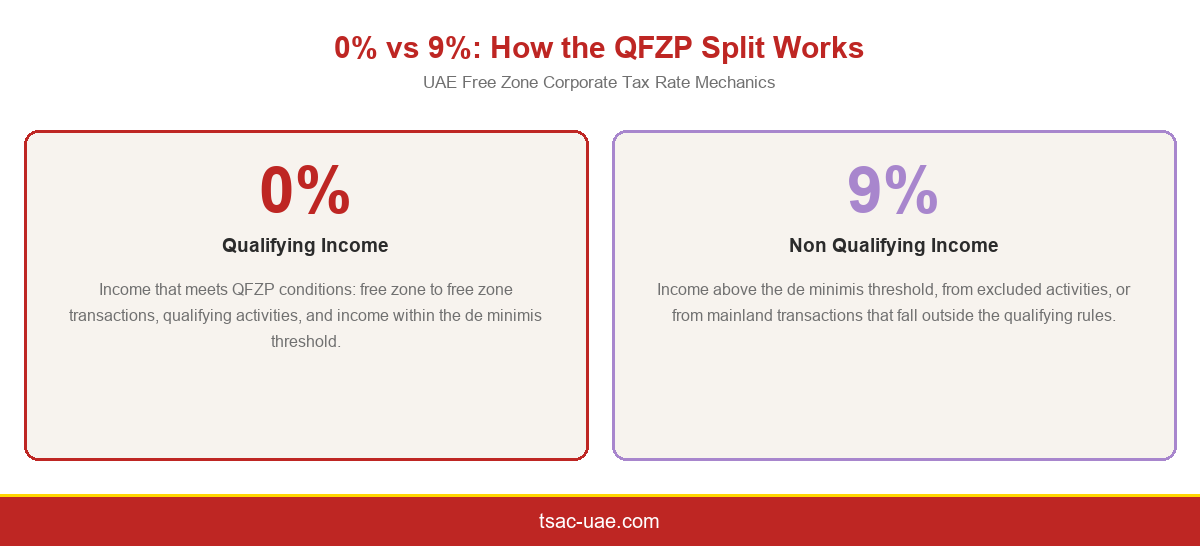
The QFZP regime does not give a free zone company a blanket 0 percent rate. It splits income into two buckets inside
the same entity, and each bucket is taxed differently. Qualifying income is taxed at 0 percent. Everything else,
including income that fails the qualifying tests, is taxed at the standard 9 percent rate once it exceeds the AED
375,000 threshold that applies economy wide. Our team frames this for clients as a
strategic declaration of your business, because how you classify income directly shapes your effective tax rate for the year.
Why the Split Catches Businesses Off Guard
Most disputes we see are not about the headline rate. They are about which invoices, contracts, and revenue lines
actually belong in the qualifying bucket. A free zone logistics company invoicing a mainland client, a consultancy
billing a related party outside the UAE, or a trading business mixing free zone and mainland customers can all end up
with income split across both rates in the same financial year. Getting this wrong in either direction either
overstates your tax liability or creates an exposure the FTA can flag later.
What This Means for Your Business
If your finance team cannot point to which revenue lines are qualifying and which are not, right now, that is the
first gap to close. This is exactly where a dedicated point of contact who understands your specific licence, activity
code, and customer base earns their fee. Generic guidance cannot classify your invoices for you. Review our
UAE corporate tax and VAT changes explainer for how
this interacts with your VAT position, since the two regimes are assessed separately but often reviewed together
during an FTA audit.
Qualifying Income: What Counts Toward Your 0% Rate
Qualifying income covers a defined set of activities and transaction types. Broadly, it includes income from
transactions with other free zone persons that are the beneficial recipient of the relevant services or goods, income
from qualifying activities regardless of who the counterparty is, and income from owning or exploiting qualifying
intellectual property, subject to specific rules. Income earned from excluded activities never qualifies, no matter
how the transaction is structured.
Qualifying Activities in Practice
- Manufacturing and processing of goods or materials within the free zone.
- Holding of shares and other securities for investment purposes.
- Ownership, management, and operation of ships.
- Reinsurance, fund management, and wealth and investment management services that meet regulatory conditions.
- Headquarters services, treasury and financing services provided to related parties.
- Financing and leasing of aircraft, including engines and rotable components.
- Distribution of goods from a designated zone, and logistics services.
Excluded Activities That Break the 0% Rate
Certain activities are always excluded from qualifying income, regardless of counterparty or contract wording. These
include most transactions with natural persons, banking and most insurance activities outside specific exceptions,
finance and leasing activities outside the qualifying scope, ownership or exploitation of immovable property other
than commercial property transacted with other free zone persons, and any activity ancillary to an excluded activity.
If your business touches any of these, that revenue line sits in the 9 percent bucket by default. Our article on
interest deductibility under UAE corporate tax
is a useful companion read if financing income forms part of your revenue mix.
This is also where related party structures need extra care. If your group includes
family foundations or intercompany
financing arrangements, the classification exercise gets more technical, and downward
transfer pricing adjustments can affect
how qualifying income is measured for the free zone entity making the payment or receiving it.
Designated zones add a further layer worth understanding early. Goods transactions within and between designated zones
receive additional qualifying treatment that does not automatically extend to services businesses operating in the
same physical location. A single free zone can host both a trading company benefiting from designated zone rules and a
services company that does not, simply because of what each entity actually sells. Confirming which category your
business falls into, before you build your income classification model, avoids rework later at filing time.
Adequate Substance: CIGAs, Assets, Employees, and Operating Expenditure
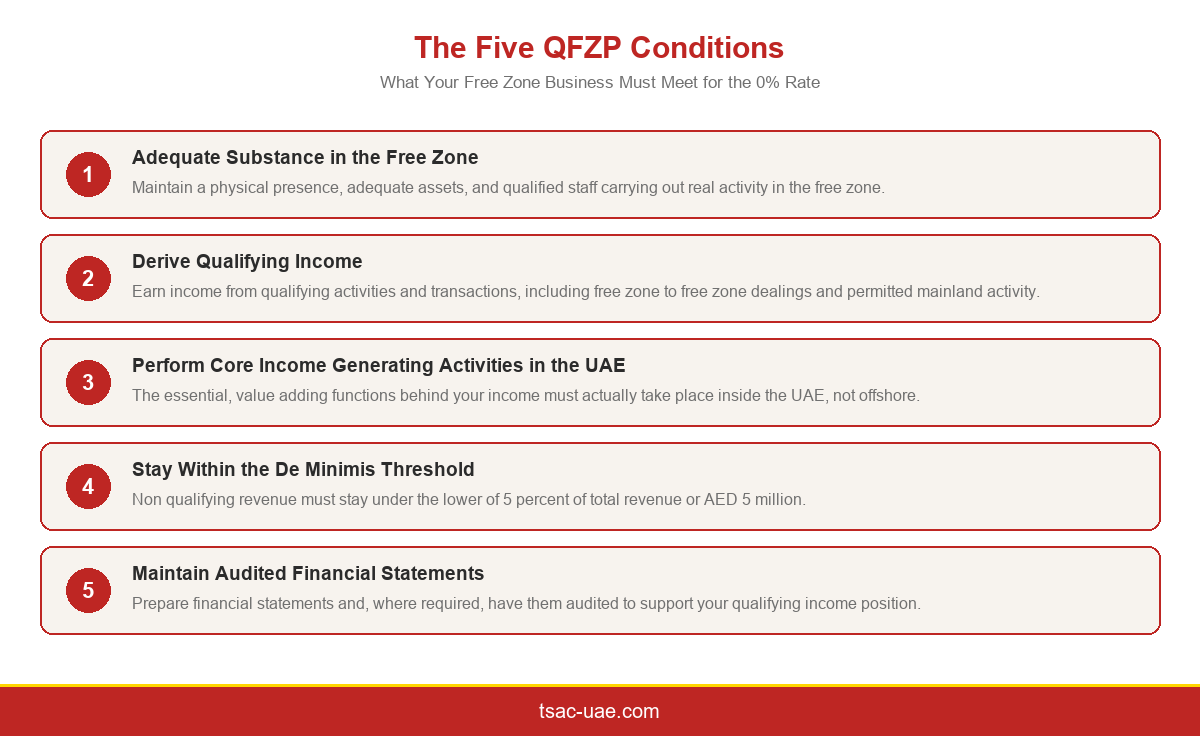
Adequate substance is the condition that trips up the most SME and mid market free zone businesses, because it is
judged on facts, not paperwork. To meet it, your free zone entity must undertake its Core Income Generating
Activities, commonly shortened to CIGAs, inside the free zone, and must have adequate assets, adequate qualified full
time employees, and adequate operating expenditure to support that activity. The word adequate is doing a lot of work
here, and the FTA assesses it relative to the scale and nature of your specific business, not against a fixed
checklist.
What Counts as a CIGA
A Core Income Generating Activity is the essential function that actually produces your income, not the administrative
work around it. For a distribution business, that might be inventory management, order fulfilment, and logistics
coordination. For a fund manager, it is investment decision making and portfolio management. For a headquarters
entity, it is the strategic and operational decisions taken on behalf of the group. If these functions are outsourced
to another jurisdiction, or performed by staff who are not physically based in the free zone, the substance test is at
risk regardless of how the entity is structured on paper.
Assets, Employees, and Operating Expenditure
The law does not set a fixed headcount or a fixed spend threshold. Instead, it requires a level of assets, staff, and
expenditure that is proportionate to the income being generated and the activity being carried out. A small
consultancy with two qualified staff working from a flexi desk may satisfy the test for its scale, while a logistics
operator claiming substantial qualifying income with no warehouse, no equipment, and no operational staff will not.
This is precisely why dashboard reporting and ongoing tracking matter more than a one time substance memo filed at
registration.
A practical way to think about substance is as a live file, not a document you write once. TSAC builds this into
client engagements through a dedicated point of contact who tracks headcount, premises, and CIGA evidence throughout
the year, alongside our broader
economic substance regulations compliance work,
so the file is ready before an FTA review, not assembled under pressure after one starts.
- Checklist: Can you name the specific CIGAs your free zone entity performs, in one sentence each.
- Checklist: Do you have signed employment contracts and UAE payroll records for the staff performing those CIGAs.
-
Checklist: Does your operating expenditure in the free zone reasonably match the income you are claiming as
qualifying. - Checklist: Is your physical premises appropriate for the activity, not just a mailbox address.
In our experience, the businesses that pass a substance review comfortably are the ones that keep this evidence
current throughout the year rather than reconstructing it at filing time. That typically means an up to date
organisation chart mapped to CIGAs, monthly payroll records for free zone based staff, a lease or licence document
that matches the stated activity, and a simple ledger tagging revenue by qualifying category as it is invoiced. None
of this requires sophisticated systems. It requires consistency, and a dedicated point of contact who checks the file
every quarter rather than once a year is usually the difference between a smooth review and a scramble.
The De Minimis Rule: How Much Non Qualifying Income You Can Have
A Qualifying Free Zone Person is allowed a limited amount of non qualifying revenue without losing 0 percent treatment
on its qualifying income. This is the de minimis threshold, and it is calculated as the lower of 5 percent of total
revenue or AED 5 million in any given tax period. If non qualifying revenue exceeds that threshold, the consequence is
not a partial adjustment. The entity loses QFZP status for the current tax period and the following four tax periods,
a total of five years, and the standard 9 percent rate applies to all of its income during that window.
This is arguably the single highest stakes number in the entire regime for SME businesses, because breaching it by
even a small margin triggers a five year consequence, not a proportional one. A distributor that picks up one large
mainland contract in a strong sales quarter can inadvertently blow through the AED 5 million cap while total revenue
is still modest, simply because the two thresholds interact. Our guide on
why effective corporate tax planning is crucial for your business
covers how to model this risk before it happens rather than after.
Tracking this in real time, rather than discovering it at year end during return preparation, is exactly the kind of
ongoing monitoring a dashboard reporting relationship is built for. If your revenue mix shifts during the year, you
want to know the same month it happens, not eleven months later.
QFZP Registration: A Practical Step by Step Process
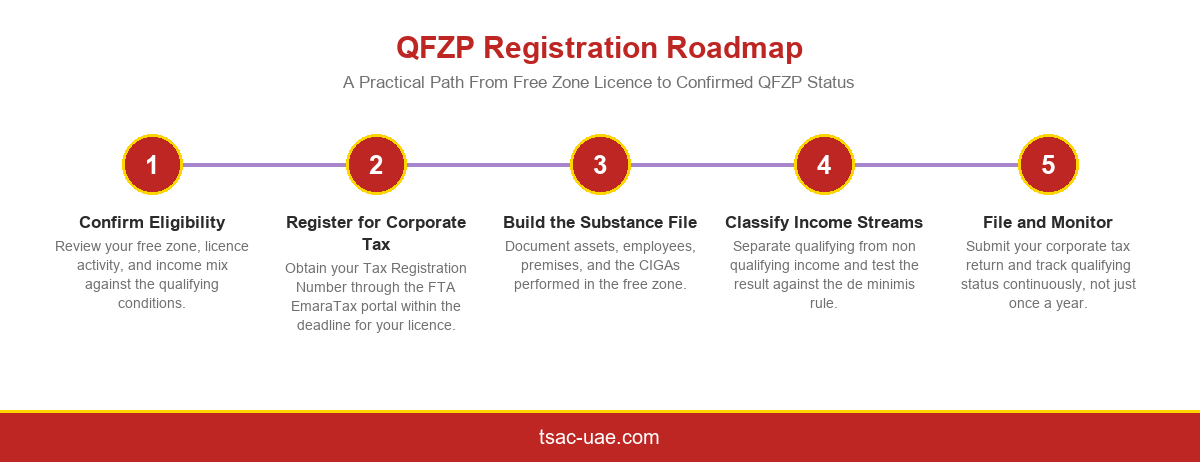
Every free zone entity, whether it ultimately qualifies for the 0 percent rate or not, must register for corporate tax
and obtain a Tax Registration Number through the FTA’s EmaraTax platform. QFZP status itself is not a separate
application. It is a position you take and support with evidence when you file your corporate tax return, which is why
the registration process and the substance and income tracking work described above need to run in parallel, not
sequentially.
If your business has not yet confirmed its
Tax Identification Number or verified its
Tax Registration Number, start
there. Our guide on how
registration shapes your filing calendar
and our companion piece on how to
keep those details current
both walk through the EmaraTax steps in more detail than we can repeat here.
Do not underestimate the cost of missing this step entirely. Our article on
the penalties for skipping this step
outlines the administrative penalties the FTA applies, and they accrue whether or not you ultimately would have
qualified for the 0 percent rate. Registration and QFZP eligibility are two separate obligations that both need
attention.
Registration deadlines are tied to your original trade licence issuance date, not to the calendar year, which is a
detail that trips up businesses managing multiple free zone entities across different licence anniversaries. A group
with three free zone companies incorporated in different months can face three separate registration deadlines in the
same year. If any of your entity information, such as licence activity, shareholding, or registered address, has
changed since incorporation, review our guidance on the
grace period to update information in tax records
before you file, since outdated FTA records can delay the substance and income assessment that QFZP status depends on.
What Happens If You Lose QFZP Status
Disqualification is not a warning system. If a Qualifying Free Zone Person fails any of the conditions, whether that
is the substance test, the qualifying income test, or the de minimis threshold, it loses QFZP status for the tax
period in which the failure occurs and for the following four tax periods. During that entire window, the entity is
taxed at the standard 9 percent rate on all of its income, not just the income that caused the failure. There is no
partial year relief and no simple reapplication the following year.
This is why the
governance side of compliance
extends well beyond the filing deadline. A single missed substance requirement, one misclassified contract, or one
quarter where non qualifying revenue crept over the de minimis line can cost a business five years of the 0 percent
rate on income that would otherwise have qualified. Our piece on the
risks of ignoring corporate tax advisory
sets out several real world scenarios where this has played out for free zone businesses that treated QFZP as a one
time filing exercise instead of an ongoing compliance position.
There is also a reputational dimension to this that owners often overlook. How
corporate tax compliance influences a company’s reputation
matters to banks, investors, and free zone authorities reviewing your licence renewal, not just to the FTA. A
disqualification event on record can complicate financing conversations well after the tax bill itself is settled.
Avoiding penalties in UAE tax compliance
is a separate question from avoiding disqualification, and both need to be managed together. A late filing penalty is
a fixed, recoverable cost. Losing QFZP status for five tax periods on income that would otherwise sit at 0 percent is
a structural cost that compounds every year the entity remains disqualified. Businesses that model both risks side by
side, rather than treating tax compliance as a single line item, make better decisions about where to invest in
advisory support.
Building a Compliance System That Keeps You Qualified
Every point above shares a common thread: QFZP status is decided by what your business actually does, tracked
continuously, not by a form filed once a year. That is precisely why TSAC built its free zone corporate tax service
around a dedicated point of contact and dashboard reporting model instead of a one off compliance memo. A named
advisor who already understands your licence, your CIGAs, and your income mix can flag a de minimis risk in month six,
not month twelve.
In practice, this means your business gets real time job tracking on substance documentation, quarterly reviews of
qualifying versus non qualifying revenue, and a single point of contact who can answer a question in a day rather than
routing it through a generalist queue. If your free zone business also handles
VAT registration and filing,
annual audits, or
electronic invoicing requirements, those
workstreams get coordinated by the same team rather than reconciled after the fact.
What This Means for SME and Mid Market Businesses
You do not need a Big 4 style technical memo that nobody outside your finance team can act on. You need a practical
answer to three questions: is our income classified correctly, is our substance file current, and are we tracking
toward or away from the de minimis threshold. Our
basics of corporate tax every entrepreneur should know
guide is a good starting point if your team is still building foundational knowledge, and our broader
advisory guide for Dubai businesses
explains how an advisory relationship should actually function day to day.
If you are setting up a new entity rather than reviewing an existing one, our
business incorporation services team can
structure the free zone entity with QFZP eligibility in mind from day one, and our
transaction advisory and
accounting services teams support the ongoing
bookkeeping that substance evidence depends on.
Conclusion: Treat QFZP as an Ongoing Position, Not a Filing
Qualifying Free Zone Person status gives UAE free zone businesses a genuine route to a 0 percent corporate tax rate,
but it rewards businesses that track their qualifying income, substance, and de minimis position throughout the year,
not just at filing time. The gap between businesses that keep the 0 percent rate and those that lose it for five years
usually comes down to visibility, not intent. Our team at TSAC works alongside SME and mid market free zone businesses
with a dedicated point of contact and dashboard reporting so nothing slips between filings. If you want a clear read
on where your business stands today,
book a free consultation with our corporate tax team, or
explore our full range of corporate tax services. You
can also read what other UAE businesses say about working with us on our
testimonials page.
Frequently Asked Questions
Q1. What is a Qualifying Free Zone Person under UAE corporate tax law?
A Qualifying Free Zone Person is a UAE free zone entity that meets specific conditions, including adequate substance
and qualifying income, allowing it to apply a 0 percent corporate tax rate on qualifying income instead of the
standard 9 percent rate.
Q2. How is free zone corporate tax different from mainland corporate tax?
Mainland businesses pay 9 percent on all profit above AED 375,000. Free zone businesses that qualify as a QFZP pay 0
percent on qualifying income only, while non qualifying income is still taxed at 9 percent above the same threshold.
Q3. What is the de minimis threshold for QFZP status?
The de minimis threshold is the lower of 5 percent of total revenue or AED 5 million in a tax period. Non qualifying
revenue above that threshold causes the entity to lose QFZP status for five tax periods.
Q4. Do all free zone companies automatically get the 0 percent tax rate?
No. A free zone licence alone does not grant the 0 percent rate. The entity must separately meet the adequate
substance, qualifying income, and de minimis conditions each tax period to keep QFZP status.
Q5. What counts as adequate substance for a free zone business?
Adequate substance means having enough qualified employees, assets, and operating expenditure in the free zone to
genuinely perform the Core Income Generating Activities behind your income, proportionate to your scale.
Q6. What happens if a free zone business loses its QFZP status?
The entity is taxed at the standard 9 percent rate on all of its income, not just the disqualifying portion, for the
current tax period and the following four tax periods.
Q7. Does every free zone entity need to register for corporate tax?
Yes. Every free zone person must register for corporate tax and obtain a Tax Registration Number through EmaraTax,
regardless of whether it ultimately qualifies for the 0 percent rate.
Q8. Can a free zone business have both qualifying and non qualifying income?
Yes. Many free zone entities earn a mix of both. Qualifying income is taxed at 0 percent and non qualifying income at
9 percent, as long as non qualifying income stays under the de minimis threshold.
Q9. How often does QFZP status need to be reviewed?
QFZP conditions apply on an ongoing basis, not just at registration. Businesses should review substance, income
classification, and de minimis exposure at least quarterly, since status can change within a single tax period.
Q10. Where can I get help assessing my free zone business’s QFZP eligibility?
TSAC’s corporate tax services team reviews free zone eligibility with a dedicated point of contact model. You can also
check common questions on our FAQs page or read our about page to learn more about our approach.