
Choosing between audit firms in Sharjah starts with one question: does your licence actually need an audit? For most companies in Sharjah and Ajman free zones, the answer is yes, and the deadline is tied to licence renewal. Mainland companies face a similar duty under federal company law. Corporate tax has now added a second reason to keep audited accounts on file. This guide explains who must file, how approved auditor lists work, and how to plan the timeline. If you want the audit handled end to end, our audit team can help.
Key Takeaways
- Most Sharjah and Ajman free zone companies should expect audited financial statements to be part of licence renewal.
- An auditor must hold a valid UAE licence, and some free zone authorities also expect them to appear on their own accepted list.
- Corporate tax rules require audited statements for Qualifying Free Zone Persons and for businesses with revenue above AED 50 million.
Which Sharjah and Ajman Companies Need an Annual Audit?
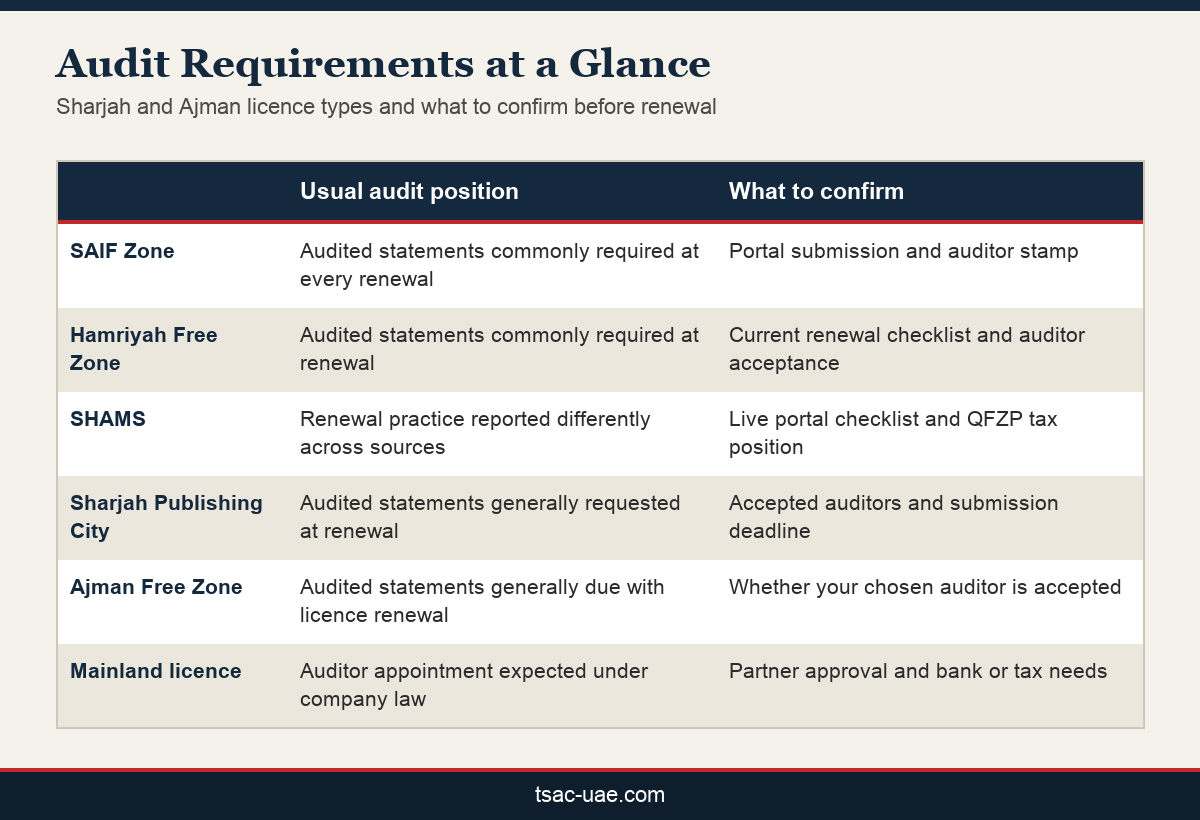
Most free zone companies in Sharjah and Ajman submit audited financial statements as part of yearly licence renewal. That includes entities in SAIF Zone, Hamriyah Free Zone, Sharjah Publishing City and Ajman Free Zone. Mainland companies also need an appointed auditor under federal company law. The exact checklist varies, so confirm it with your authority each year.
Free zone authorities use the audit to confirm that a licensed company is active, solvent and trading within its permitted activities. SAIF Zone and Hamriyah Free Zone are widely reported to require audited accounts for every licence, whatever the turnover. Sharjah Publishing City and Ajman Free Zone generally follow the same approach for trading, service and industrial licences.
Sharjah Media City (SHAMS) is the zone where advice differs most. Some sources say an audit is a renewal condition, while others say renewal only needs the fee and lease documents. Do not rely on old forums or a previous year’s experience. Check the current renewal checklist in your licence portal before you assume either answer.
Mainland companies licensed by the Sharjah or Ajman economic departments sit under the Commercial Companies Law. That law expects limited liability companies to appoint an auditor and present annual accounts to their partners. Banks, landlords and investors also ask for audited statements, so skipping the audit rarely saves money in practice. Lenders in particular often refuse facility renewals without a signed report.
How Approved Auditor Lists Work for Audit Firms in Sharjah
Every statutory auditor in the UAE must hold a valid licence and be registered with the Ministry of Economy. Some free zone authorities add their own layer and only accept reports from firms they have registered. Before you sign an engagement letter, ask the firm to confirm in writing that your authority accepts its report.
The phrase approved auditor causes real confusion. At the federal level, it means a firm and a partner registered to practise audit in the UAE. At the free zone level, it can mean a firm that has also registered with that authority and can upload reports to its portal.
Practices differ across zones. SAIF Zone reports are typically signed and stamped by the auditor and submitted through the zone’s own system. For audit firms in Ajman, accounts from the market vary: some say Ajman Free Zone keeps an approved list, while others describe it as open to any licensed firm. Treat that as a reason to verify, not a reason to guess. The same check applies to audit firms in Sharjah that serve several zones at once.
A rejected report is the costly outcome. If the authority does not accept your auditor, you pay for a second audit and your renewal stalls. Asking two questions at the proposal stage avoids that. Is the firm accepted by my authority, and who signs the report?
Audit Timelines and the Licence Renewal Link
The audit deadline that matters most is your licence expiry date, not the calendar year. Free zones commonly expect audited statements within three to four months of the financial year end. Work backwards from renewal, close your books early, and leave the auditor enough time for queries. A late report can delay renewal, visas and banking.
Start with a clean trial balance and reconciled bank accounts. Most delays come from missing invoices, unexplained related party balances and fixed assets with no supporting documents. Keeping your books audit ready through the year shortens fieldwork and cuts the number of follow up questions.
Next, agree the scope and dates with your auditor at least two months before the report is due. Share the previous year’s signed statements, the licence copy, the share register and key contracts. The auditor then tests balances, reviews estimates and issues draft statements for management review.
Finally, plan for signatures. Directors approve the statements, the auditor signs the report, and you upload it to the authority. If your licence renews soon after year end, consider aligning the financial year with the renewal cycle so the two deadlines stop colliding.
The Corporate Tax Angle: Audited Statements for QFZPs and Large Businesses
Corporate tax gives Sharjah and Ajman companies a second reason to audit. Under Ministerial Decision No. 82 of 2023, Qualifying Free Zone Persons must prepare audited financial statements, whatever their revenue. Any business with revenue above AED 50 million must also do so. These statements support the corporate tax return and the claim to the 0% rate.
The rule is set out in Ministerial Decision No. 82 of 2023, issued under the Corporate Tax Law. A 2025 amendment added that tax groups prepare audited aggregated statements, while their individual members do not need separate audited statements for tax purposes.
For a free zone company, the audit now does two jobs. It satisfies the licence authority, and it supports the qualifying income position in the tax return. Auditors should understand how qualifying and non qualifying income are separated, because the FTA can test that split. Our guide to record keeping rules for free zone entities covers the documents to retain.
Timing matters here too. The corporate tax return is due within nine months of the tax period end, so a delayed audit squeezes the filing window. Coordinate the audit with your corporate tax return support so the same numbers flow into both.
Choosing Between Audit Firms in Sharjah and Ajman
The right auditor is registered, accepted by your authority, independent of your bookkeeping and familiar with corporate tax. Price matters, but a cheap report that the free zone rejects or the FTA questions costs more later. Compare firms on acceptance, sector experience, timelines and the quality of their management letter.
Independence comes first. The firm that keeps your books should not audit them, because auditors cannot review their own work. Many SMEs use one provider for accounting and a separate firm for the statutory audit, which also gives owners a genuine second opinion.
Then look at practical fit. Ask about sector experience, the partner who will sign, expected fieldwork days and how queries are handled. A good firm explains what a statutory external audit covers before work starts, so there are no surprises in the final report.
Comparing audit firms in Sharjah on these points takes an hour and can save a full renewal cycle. Ask for a written proposal that lists scope, fee basis, deliverables and the authority acceptance confirmation. Fees vary widely with transaction volume and complexity, so compare like for like scopes.
Conclusion
Working with audit firms in Sharjah and Ajman is simpler when you treat the audit as part of your yearly calendar rather than a renewal emergency that arrives every year without warning. Confirm what your authority needs, check that your auditor is accepted, and align the audit with your corporate tax return. Founded in 2020, TSAC supports SMEs from offices in Dubai and SHAMS Media City in Sharjah. To plan this year’s audit and filing together, book a free consultation with our team and get a clear timeline for both deadlines.
Frequently Asked Questions
Do all audit firms in Sharjah qualify to audit free zone companies?
No. Every statutory auditor needs a valid UAE licence and Ministry of Economy registration, and some free zones accept reports only from firms registered with them. Ask the firm to confirm in writing that your authority accepts its reports.
Does SAIF Zone require audited financial statements for renewal?
SAIF Zone is widely reported to require audited financial statements for licence renewal, whatever the turnover. The report is usually signed and stamped by the auditor and submitted through the zone’s system. Confirm the current checklist before your renewal date.
Does SHAMS require an audit report to renew a licence?
Sources disagree on this point, so check the live renewal checklist in your SHAMS portal. Even where renewal does not require it, a SHAMS company claiming the 0% corporate tax rate as a Qualifying Free Zone Person must still prepare audited statements.
Is there an approved auditors list for Ajman Free Zone?
Advice in the market differs on whether Ajman Free Zone keeps a closed list or accepts any licensed UAE audit firm. The safe step is to confirm acceptance directly with the authority, or get written confirmation from your auditor, before work begins.
When are audited accounts usually due in Sharjah and Ajman free zones?
Many free zones expect audited statements within three to four months of the financial year end, often alongside licence renewal. Your licence expiry date is the deadline that matters most, so plan the audit backwards from it.
Do Qualifying Free Zone Persons need audited statements for corporate tax?
Yes. Ministerial Decision No. 82 of 2023 requires Qualifying Free Zone Persons to prepare audited financial statements regardless of revenue. Our registration guide for these free zones covers the earlier registration step that comes before any audit.
Do mainland companies in Sharjah need an audit?
Mainland limited liability companies are expected to appoint an auditor under the Commercial Companies Law. Any business with revenue above AED 50 million also needs audited statements for corporate tax. Compare free zone and mainland tax treatment before restructuring.
Can my bookkeeper also audit my accounts?
No. Auditors must stay independent of the records they review, so the firm preparing your books should not sign your audit report. Many SMEs keep accounting with one provider and appoint a separate firm for the statutory audit.