
Every founder setting up in the UAE eventually asks the same question: is it cheaper to run a
free zone company or a mainland
one? The honest answer is that free zone vs mainland corporate tax uae is not a single number you can compare on a
spreadsheet. It depends on where your customers sit, how your revenue splits across qualifying and non qualifying
activity, and how much compliance work you can realistically keep up with each year. This guide walks through the real
cost differences, not the marketing version, so you can make the call with your eyes open.
Key Takeaways
-
A free zone company tax uae structure can legally pay 0% on Qualifying Income, but only while it meets Qualifying
Free Zone Person conditions every single year. -
A mainland company tax uae structure pays 9% on profit above AED 375,000, with none of the free zone qualifying
activity restrictions on who it can trade with. -
The cheaper structure is the one that matches your customer base and your ability to track compliance, not the one
with the lower headline rate.
What Actually Changes Between Free Zone and Mainland Under UAE Corporate Tax
Under UAE Corporate Tax Law, every business is taxable, the question is only how much and on what. A mainland company
is taxed on its total taxable profit above AED 375,000 at 9%, in the same way most businesses around the world
understand corporate tax. A
free zone entity that meets every condition
works differently. It can apply a 0% rate to income that meets the definition of Qualifying Income, and a 9% rate to
everything else, with no free threshold cushioning the non qualifying portion, a framework the
Ministry of Finance continues to refine through cabinet and
ministerial decisions. If you want the full mechanics of how the regime was built, our earlier piece on
UAE corporate tax key highlights is a useful
primer before you compare structures. The distinction matters because a free zone company that assumes it
automatically gets 0% on everything is usually the one that gets an unpleasant surprise at filing time.
None of this changes your obligation to register. Whether you end up mainland or free zone,
registration with the FTA
is mandatory, and
missing the deadline carries
real penalties regardless of which structure you picked. Our team walks new and existing entities through this as part
of standard corporate tax services in the UAE.
The Real Cost Comparison: Free Zone Tax Benefits vs Mainland Flexibility
On paper, uae free zone tax benefits look decisive: 0% corporate tax, up to 100% foreign ownership, and often a
customs exemption inside the zone. In practice, the savings only show up if most of your revenue is genuinely
Qualifying Income. Export businesses, holding companies, logistics operators and media or tech firms that mostly
invoice outside the UAE, or to other free zone entities, tend to capture the full benefit. A services business that
sells mainly to UAE customers on the mainland often finds a large share of its revenue reclassified as non qualifying,
taxed at the standard 9% rate anyway.
Mainland companies trade this off for flexibility. There is no qualifying activity test to monitor, no de minimis
threshold to watch, and direct access to customers anywhere in the country, including government tenders that free
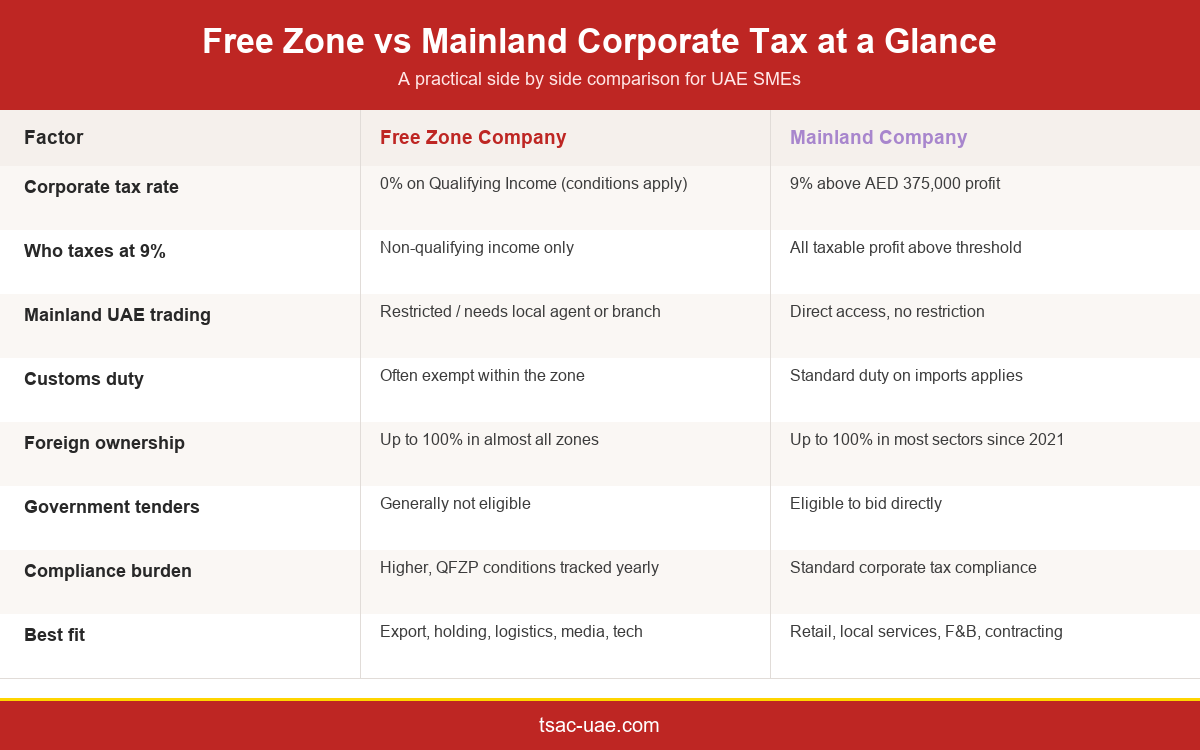
zone entities generally cannot bid on directly. The chart below sets out the factors side by side.
If part of your model involves cross border transactions,
VAT registration and filing runs on a separate timeline
from corporate tax and applies to both structures equally, so factor it into either scenario before you decide.
Where Free Zone Companies Lose the 0% Rate and Get Taxed at 9%
This is the section most free zone owners skip, and the one that costs them the most later. To keep Qualifying Free
Zone Person status, a company has to pass conditions every tax period, not once at incorporation. It needs adequate
substance in the zone, audited financial statements, and income that genuinely falls under a Qualifying Activity as
defined by the Ministry of Finance. The
Federal Tax Authority’s guide on free zone persons
sets these conditions out in detail, and it is worth having your
advisory team review them
against your actual invoicing pattern, not just your trade licence.
There is also a de minimis threshold. If non qualifying revenue exceeds 5% of total revenue, or AED 5 million,
whichever is lower, the entity loses Qualifying Free Zone Person status for that period and the following four. That
is not a small mistake to walk back. It is why
effective corporate tax planning
for free zone entities has to be revisited every year, not filed away after the first registration.
Get this wrong and the consequences compound. Beyond the extra 9% liability,
ignoring corporate tax advisory
at this stage tends to surface at the worst possible moment, usually during an audit or a due diligence exercise ahead
of investment. Our audit services and
accounting services teams frequently get called
in precisely because a free zone client’s bookkeeping was never structured to separate qualifying and non qualifying
income cleanly.
Mainland Corporate Tax: What SMEs Actually Pay in Practice
A mainland company tax uae bill is more predictable, which is exactly why some founders prefer it even without the 0%
headline. Profit up to AED 375,000 is taxed at 0% as small business relief territory, and everything above that is
taxed at a flat 9%, as set out on the
Federal Tax Authority’s corporate tax page.
There is no qualifying activity test, no de minimis threshold, and no annual re-qualification exercise. If your
business model already trades mainly with mainland UAE customers, or needs to hold government or semi-government
contracts, the flexibility usually outweighs the free zone’s 0% headline rate once you account for what actually stays
qualifying.
Mainland status also simplifies year two onward. Our breakdown of what changes in
year two of UAE corporate tax
is written for exactly this stage, when the first filing cycle is behind you and the real operational cadence, VAT
interaction, transfer pricing documentation, and
e-invoicing readiness, starts to matter more than
the initial registration.
None of this means mainland is automatically the safer or cheaper option. A mainland business still needs a
qualified adviser to manage
filing deadlines, and
penalties for late or inaccurate returns
apply exactly the same way they do to free zone entities. The point is simply that the compliance shape is different,
not necessarily lighter.
Which Structure Fits Your Business? A Practical Decision Framework
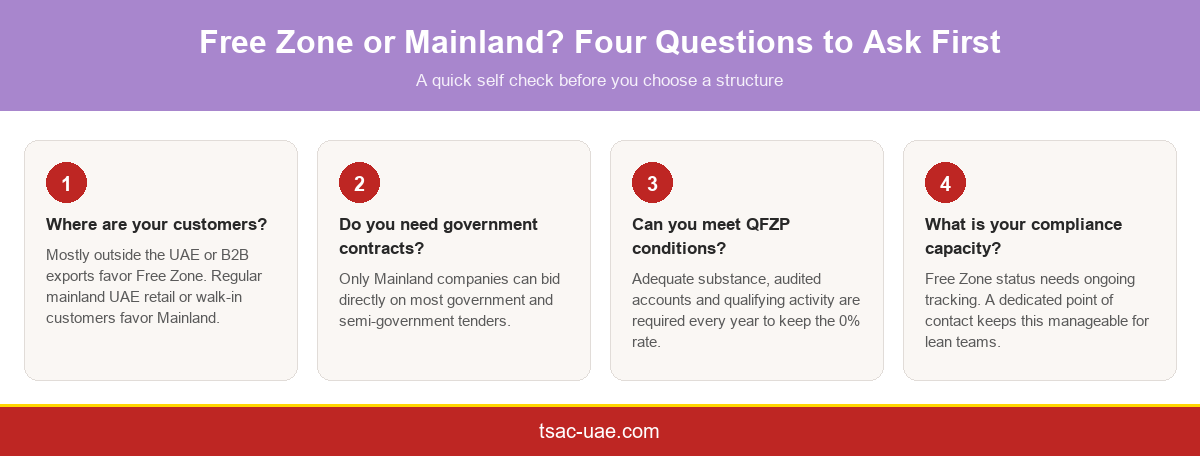
Instead of chasing the lower headline rate, work through four practical questions before you commit to either
corporate tax free zone company status or a mainland licence. Where do your customers actually sit. Do you need to bid
on government work. Can your business genuinely meet and document Qualifying Free Zone Person conditions every year.
And do you have the internal capacity, or a partner, to track that compliance continuously rather than once at setup.
This is where a generic Big 4 style summary of the law stops being useful and a practical implementation plan starts
to matter. At TSAC, every client gets a dedicated point of contact who tracks Qualifying Free Zone Person conditions,
filing deadlines and documentation through a live dashboard, rather than a static annual checklist. That real time
visibility is what actually prevents the de minimis breach or the missed deadline that turns a 0% rate into a 9%
liability. If you are weighing a new
business incorporation decision, or
reassessing a structure you already have, our
corporate tax services and
transaction advisory teams can model both scenarios
against your actual revenue mix before you file anything.
It also helps to look at this alongside your wider compliance calendar.
Economic Substance Regulations obligations,
VAT filing cycles and
corporate tax compliance
all move on different clocks, and a structure that looks cheaper on tax alone can still cost more once you add up the
administrative overhead of running three separate compliance tracks without a single point of coordination.
Get a Structure Comparison Built Around Your Numbers
There is no universal winner in the free zone vs mainland corporate tax uae decision. A free zone structure rewards
businesses with genuinely qualifying, well documented income. A mainland structure rewards businesses that need direct
market access and predictable filing. What actually determines your cost is how closely your real operations match the
structure you chose, and whether someone is tracking that match all year, not just at renewal. Our advisors
review your current setup, model both structures against your revenue, and give you a straight answer, then keep
monitoring the result
through a dedicated point of contact and dashboard reporting so the decision stays right as your business grows. You
can also browse client testimonials or check our
FAQs for common questions before you book a call.
Frequently Asked Questions
Is free zone or mainland cheaper for UAE corporate tax?
Neither is cheaper by default. A free zone company pays 0% only on Qualifying Income, while a mainland company pays 9%
above AED 375,000 profit with no qualifying activity restrictions. The real cost depends on how much of your revenue
actually qualifies each year.
What is the corporate tax rate for a UAE free zone company?
A Qualifying Free Zone Person pays 0% on Qualifying Income and 9% on non qualifying income. Losing qualifying status
for any reason moves the entire relevant income into the 9% bracket for that period.
Can a free zone company trade with mainland UAE customers?
Yes, but that income is generally treated as non qualifying and taxed at 9% unless it falls under a specific
exception. Heavy mainland trading is one of the main reasons free zone tax benefits shrink in practice.
What happens if a free zone company fails the QFZP conditions?
It loses Qualifying Free Zone Person status for the current period and the following four tax periods, and its income
is taxed at the standard 9% rate for that entire window, even if it later becomes compliant again.
Does a mainland company get any 0% corporate tax relief?
Yes. Taxable profit up to AED 375,000 is taxed at 0% for all UAE businesses, mainland or free zone, as part of the
standard rate structure, not a separate incentive.
Is VAT different between free zone and mainland companies?
VAT registration and filing thresholds apply the same way regardless of structure. See our VAT services page for
current registration thresholds and filing obligations.
Can a free zone company convert to mainland later?
Yes, businesses can restructure from free zone to mainland or maintain both, though it affects licensing, ownership
documentation and the corporate tax treatment going forward. Get advice before restructuring mid tax period.
Do free zone companies still need to register for corporate tax?
Yes. Registration is mandatory for all taxable persons in the UAE, including free zone entities with 0% qualifying
income. See our guide on what happens if you do not register for the penalties involved.
How often are Qualifying Free Zone Person conditions checked?
Every tax period. It is not a one time qualification at setup. Substance, audited accounts and income composition all
need to hold up annually, which is why ongoing tracking matters more than the initial registration decision.
Which UAE businesses benefit most from mainland structure?
Businesses that sell primarily to UAE mainland customers, need government contract eligibility, or want to avoid
annual qualifying activity testing tend to find mainland status more practical despite the 9% rate above the
threshold.