
A tax residency certificate uae application is the document that turns UAE incorporation into a usable tax residency claim abroad. Without it, a company cannot invoke the country’s double tax treaties, no matter how long it has operated here. This guide covers who qualifies, what the FTA asks for, and how the process actually runs from application to certificate in hand, so a business can plan the paperwork well before a foreign counterparty or tax authority asks for it.
Key Takeaways
- A company TRC application is judged on real presence in the UAE, not just a trade license, so audited financials and a registered office lease matter as much as the application form itself.
- FTA fees for a TRC are tiered by applicant type, and processing is handled entirely through the online TRC portal linked from EmaraTax.
- A TRC is only useful once a business identifies which specific double tax treaty provision it needs to claim, since the certificate itself does not calculate treaty relief automatically.
What a Tax Residency Certificate Actually Proves
A Tax Residency Certificate is issued by the Federal Tax Authority to confirm that a company, or an individual, is a tax resident of the UAE for a defined period, usually one financial year. The FTA’s own TRC guidance describes it as the document that allows an applicant to benefit from the provisions of a double taxation agreement signed between the UAE and another country. In practice, this means the certificate itself does not reduce anyone’s tax bill. It is the evidence a foreign tax authority or counterparty will ask for before they apply a reduced withholding tax rate or accept that income has already been fairly taxed once in the UAE.
It is worth distinguishing this from a company’s trade license, which simply confirms a business is legally permitted to operate in the UAE. A trade license alone does not prove tax residency to a foreign authority, and companies sometimes assume that incorporation is enough evidence on its own. The TRC exists precisely because foreign tax authorities want an FTA issued document, not just a locally issued trade license, before they will apply a treaty rate.
The certificate also carries weight with banks, not only foreign tax authorities. A UAE company opening an account with an overseas bank, or supporting a cross border loan application, is often asked for a TRC as part of standard due diligence, since it gives the bank independent, FTA verified confirmation of where the company is actually resident for tax purposes.
Who Should Apply for a Company TRC
Any UAE registered company that receives cross border income, such as dividends, interest, royalties or management fees from a country the UAE has a treaty with, is a candidate for a TRC. This is common for holding companies, group treasury entities, trading businesses with overseas suppliers, and any UAE company lending to or borrowing from an affiliate abroad. A purely domestic UAE business with no foreign income generally has no practical use for a TRC, since there is no treaty relief to claim.
It is also common for a company’s need for a TRC to emerge gradually rather than at incorporation. A trading business that starts out serving only the local UAE market may, a few years later, begin importing directly from an overseas manufacturer or opening a foreign bank account for a new supplier relationship. At that point, a TRC becomes relevant even though it was not needed when the company was first set up, which is why it is worth reviewing cross border activity annually rather than assuming past practice still reflects the current business.
Group structures deserve particular attention here. A UAE parent company that receives dividends from a foreign subsidiary, or a UAE entity that charges a management fee to an overseas affiliate, is exactly the kind of applicant a TRC is designed for, and delaying the application until a specific payment is due rather than applying proactively each year is the most common reason these businesses miss available treaty relief.
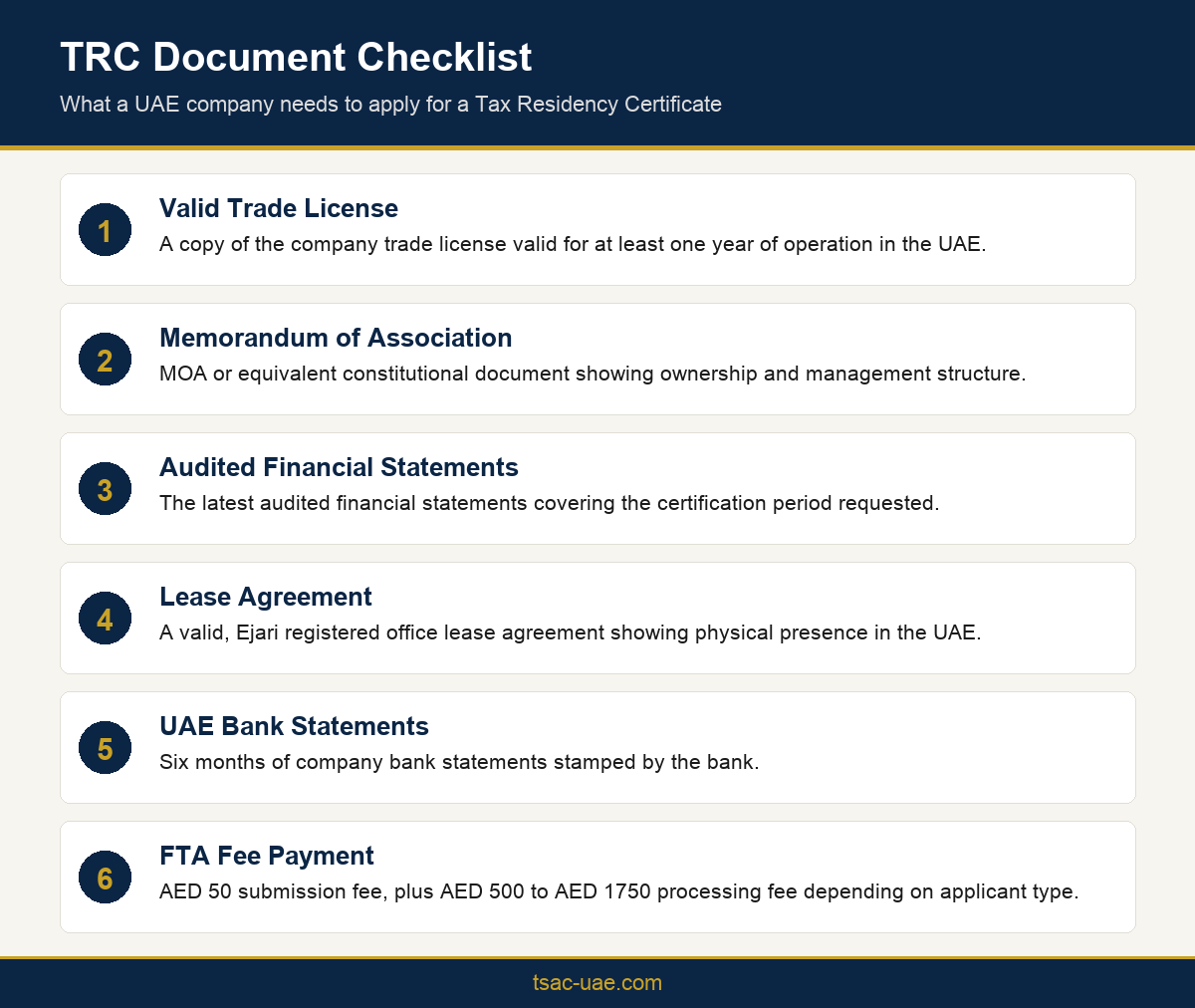
The six document categories the FTA typically requests for a company TRC application.
The Documents the FTA Actually Asks For
A company applying for a TRC needs a valid trade license covering at least one year of operation, a Memorandum of Association or equivalent constitutional document, audited financial statements for the period being certified, an Ejari registered office lease, and six months of stamped bank statements. This is exactly why TRC readiness is really a byproduct of good ongoing accounting and audit practice rather than a one time paperwork exercise. A company that keeps its corporate tax filings and audited accounts current rarely struggles to assemble a TRC application quickly.
Companies that only prepare audited financials once a year, close to a license renewal deadline, sometimes find those statements are already several months out of date by the time a TRC application needs to be submitted for a different period. Coordinating the timing of the annual audit with anticipated TRC needs, rather than treating the two as unrelated calendar items, avoids this gap.
It is also worth checking that the company name, shareholder details and license number are identical across every document submitted. A trade license that lists a trading name while the MOA lists only the full legal name is a common, avoidable source of an FTA query, since it forces the reviewing officer to stop and confirm the documents actually describe the same entity.
Fees, Processing Time and the Online Portal
TRC applications are submitted through the FTA’s dedicated TRC service, accessible via an EmaraTax linked login. The current fee structure includes a submission fee alongside a processing fee that varies by applicant type, with a lower rate for existing tax registrants than for non-registered applicants. Processing typically takes a small number of business days once a complete file is submitted, though incomplete documentation is the most common cause of delay. Because the certificate references a specific certification period, most companies apply annually rather than treating a TRC as a one off document.
Businesses that anticipate needing a TRC every year, such as a group treasury company or a business with a recurring cross border royalty arrangement, benefit from building the application into their annual compliance calendar alongside corporate tax filing and audit sign off, rather than waiting for a specific request from a bank or foreign tax authority before starting the process.
The portal itself keeps a history of past certificates issued to an applicant, which makes renewal faster in subsequent years since much of the underlying company information does not need to be entered again from scratch. First applications tend to take longer simply because the company profile has to be built within the system for the first time.
Why the Sharjah Angle Matters
For companies registered with Sharjah Media City or operating from Sharjah more broadly, the underlying documents behind a TRC application often need coordination between the free zone authority and the FTA, particularly around lease registration and audited financials tied to free zone renewal cycles. A separate guide in this series covers Sharjah and Ajman free zone registration specifics in more depth, which is worth reading alongside this one if your TRC applicant is a free zone entity.
In practice, a Sharjah free zone company that times its annual auditor renewal to align with its corporate tax filing and any anticipated TRC application saves itself from producing overlapping sets of financial statements for what is effectively the same reporting period.
TSAC’s presence in Sharjah Media City means these coordination points are handled directly by a team that already works with the free zone authority on renewals, rather than a Dubai based advisor treating a Sharjah TRC application as a one off request outside its usual workflow.
Conclusion
A tax residency certificate uae application is straightforward once a company’s underlying records are in order, and genuinely difficult when they are not. The fastest route to a clean certificate is treating TRC readiness as a natural extension of accurate corporate tax and accounting compliance, not a separate scramble once a foreign counterparty asks for proof of residency. Speak to TSAC before your next TRC renewal is due to confirm your documentation is ready.
Frequently Asked Questions
How long is a UAE tax residency certificate valid for?
A TRC certifies residency for a specific period, typically one financial year, so most companies with ongoing cross border income reapply annually rather than relying on a single certificate indefinitely.
Can a UAE free zone company get a tax residency certificate?
Yes, free zone companies can apply for a TRC provided they meet the same substance and documentation requirements as mainland companies, including audited financials and a registered lease.
What is the fee for a UAE tax residency certificate?
The FTA charges a submission fee plus a processing fee that varies depending on whether the applicant is an existing tax registrant, with different tiers for registered and non-registered applicants.
Do individuals need the same documents as companies for a TRC?
No, individual applicants submit personal documents such as passport, visa and proof of UAE residence, while company applicants submit trade license, MOA, audited financials and lease documents.
Is a tax residency certificate the same as a tax registration number?
No. A Tax Registration Number is issued when a company registers for corporate tax or VAT. A TRC is a separate certificate confirming tax residency for treaty purposes.
What happens if my company does not have audited financials yet?
Without audited financials for the relevant period, a TRC application is likely to be delayed or rejected, since the FTA uses these statements as core evidence of genuine UAE operations.
Which countries does the UAE have double tax treaties with?
The UAE has signed agreements with more than 130 countries, covering most major trading and investment partners, as tracked on the Ministry of Finance treaties dashboard.
Can a registered tax agent apply for a TRC on my company’s behalf?
Yes, a registered tax agent can prepare and submit a TRC application on a company’s behalf, which is useful when the applicant is unfamiliar with the EmaraTax linked portal.