Corporate tax in uae registration follows one federal law, but Sharjah and Ajman free zone companies face requirements that a Dubai mainland business does not always encounter in the same form. This guide sets out exactly what is different, drawing on TSAC’s own presence in Sharjah Media City to explain how local free zone authority requirements interact with FTA registration, so a business owner in either emirate knows precisely what to expect at registration and renewal, rather than applying assumptions drawn from a Dubai focused advisor or a generic online guide that does not account for the free zone layer.
Key Takeaways
- Sharjah and Ajman free zone companies register for corporate tax with the FTA in the same way as any other UAE entity, but renewal with the free zone authority often adds an approved auditor requirement.
- Qualifying free zone status, which unlocks a 0 percent rate on qualifying income, is assessed at the individual free zone level and should never be assumed to carry over from a Dubai precedent.
- A local office presence, such as TSAC’s Al Bataeh location in Sharjah Media City, makes coordinating free zone renewal and FTA filings considerably faster for companies in these emirates.
The Same Federal Law, a Different Local Layer
Corporate tax registration itself is governed by federal law and processed through the same EmaraTax platform regardless of which emirate or free zone a company is licensed in. What changes for Sharjah Media City and Ajman Free Zone companies is the additional layer of free zone authority renewal that sits alongside the FTA registration, and this is where most confusion happens for business owners moving from a Dubai reference point.
This confusion is understandable given how much general UAE tax content defaults to Dubai examples. A Sharjah or Ajman based business reading generic guidance may correctly understand the federal corporate tax rules, yet still miss a free zone specific renewal requirement that a Dubai focused article never mentions because it does not apply there in the same way.
The safest approach for a Sharjah or Ajman business owner is to treat the free zone authority and the FTA as two separate regulators that both need to be satisfied every year, rather than assuming that satisfying one automatically satisfies the other. They ask for related but not identical documentation, on their own separate timelines.
Qualifying Free Zone Person Status Is Assessed Locally
A free zone company that wants the 0 percent corporate tax rate on qualifying income must meet substance requirements, maintain adequate assets and staff, and earn income that falls within the qualifying activities list. These conditions are assessed by reference to the specific free zone authority a company is licensed under, which means a Sharjah or Ajman entity should not assume that qualifying status granted to a comparable Dubai free zone company will apply automatically to its own filing.
In practice, this means a Sharjah or Ajman free zone company should review its qualifying status each year as part of its corporate tax filing preparation, rather than treating an initial qualifying determination as permanent. A change in the company’s income mix, for example a shift toward services provided to mainland UAE customers, can affect whether qualifying income conditions continue to be met.
A practical way to manage this is to review the qualifying activities list against the company’s actual revenue lines each year at filing time, rather than relying on the assessment made when the company was first licensed. Businesses that grow into new service lines over time are the ones most likely to drift out of qualifying status without noticing.
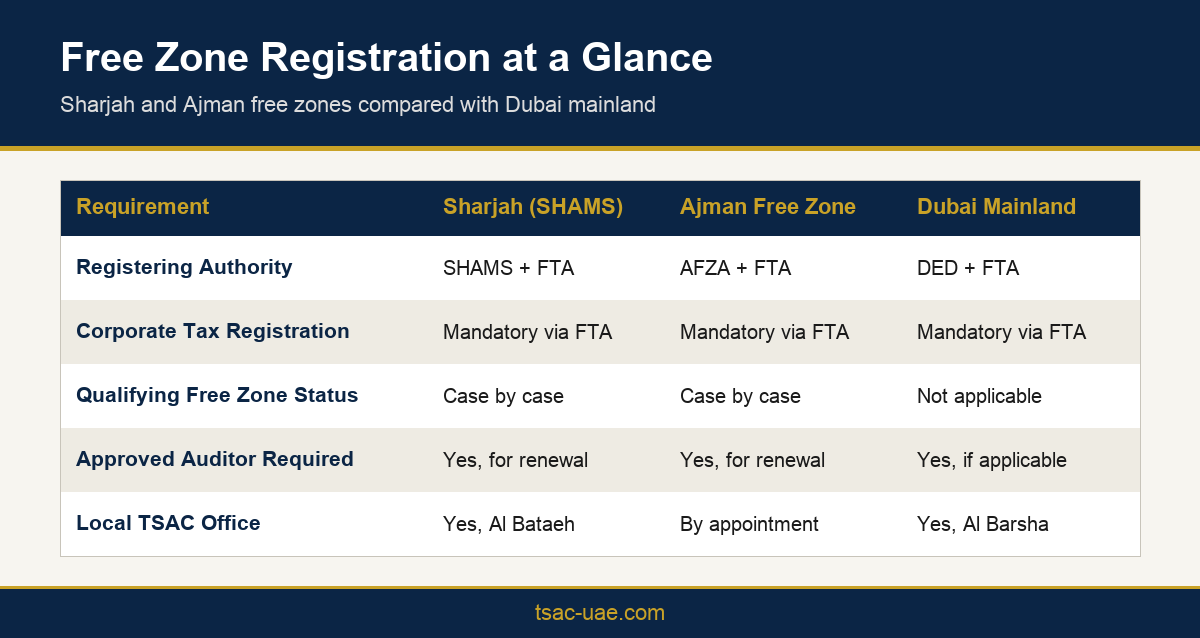
Registration and renewal requirements compared across Sharjah, Ajman and Dubai mainland.
Approved Auditor Requirements at Renewal
Most Sharjah and Ajman free zone licenses require an approved auditor’s report as part of the annual license renewal, separate from any statutory corporate tax filing obligation. TSAC’s own audit services team frequently coordinates this renewal audit alongside a client’s corporate tax filing, since both draw on the same underlying financial records and timing them together avoids preparing similar documentation twice in the same year.
Businesses that leave the audit until the last few weeks before license renewal often find themselves working against a tighter deadline than they realised, particularly if their bookkeeping is not fully up to date going into the audit. Scheduling the annual audit a reasonable window ahead of the renewal date, rather than at the deadline itself, gives more room to resolve any queries the auditor raises.
Choosing an auditor who is specifically approved by the relevant free zone authority also matters. Not every licensed auditor in the UAE appears on every free zone authority’s approved list, and submitting a report from an auditor who is not approved for that particular free zone can delay renewal even when the underlying financial statements are perfectly sound.
What This Means for Tax Residency Certificate Applications
Because a tax residency certificate application depends on audited financials and a registered lease, Sharjah and Ajman free zone companies benefit from aligning their free zone auditor renewal cycle with their corporate tax filing calendar. Doing this well in advance means a TRC application, when needed, can draw on documents that are already current rather than requiring a rushed audit update.
This alignment is particularly valuable for holding or trading companies in these free zones that regularly deal with overseas counterparties, since a TRC request from a foreign bank or tax authority often arrives with limited notice, and having audited financials already prepared removes the biggest source of delay.
Free zone entities with cross border shareholders should build this alignment into their annual planning from the first year of operation rather than waiting until a specific TRC request arrives, since retroactively producing audited financials for an earlier period is far harder than keeping the audit current each year as it happens.
Why a Local Office Presence Matters
TSAC operates from Sharjah Media City in Al Bataeh as well as its Al Barsha office in Dubai, which means Sharjah and Ajman based clients deal with an advisor who understands the specific free zone authority’s renewal calendar rather than treating it as a generic add on to a Dubai focused practice. This matters most at renewal time, when free zone authority deadlines and FTA filing deadlines do not always align.
A locally present advisor is also better placed to flag changes at the free zone authority level as they happen, rather than a client discovering a new requirement only when their renewal application is queried.
For a business weighing whether to set up in Sharjah, Ajman or Dubai in the first place, this kind of local familiarity is worth asking a prospective advisor about directly. An advisor who can describe the specific renewal calendar of the free zone in question, rather than speaking only in general federal terms, is signalling real hands on experience in that emirate.
Conclusion
Corporate tax in uae registration is federally consistent, but Sharjah and Ajman free zone companies carry an extra layer of local renewal and qualifying status assessment that a mainland company does not face in the same way. Treating the free zone authority renewal and the FTA registration as two connected parts of the same annual cycle, rather than separate tasks, is the most reliable way to avoid a gap at renewal time. Businesses that review qualifying free zone status, auditor renewal and TRC readiness together each year, rather than as three unrelated tasks, consistently find renewal season far less stressful than those that address each requirement only as it becomes urgent. TSAC’s Sharjah office can walk through both requirements together.
Frequently Asked Questions
Do Sharjah free zone companies register for corporate tax differently than Dubai companies?
The FTA registration process on EmaraTax is the same, but Sharjah free zone companies also face free zone authority renewal requirements, including an approved auditor’s report, that mainland companies handle differently.
What is qualifying free zone person status?
It is a status that allows a free zone company meeting substance and income conditions to pay 0 percent corporate tax on qualifying income, assessed individually by each free zone authority.
Does Ajman Free Zone have the same corporate tax rules as Sharjah?
Both follow the same federal corporate tax law, but each free zone authority, including Ajman Free Zone, sets its own renewal and auditor requirements separately from Sharjah’s.
Is an approved auditor required for Sharjah free zone companies?
Most Sharjah free zone licenses require an approved auditor’s report at annual renewal, in addition to any corporate tax filing obligation under federal law.
Can a Sharjah free zone company apply for a UAE tax residency certificate?
Yes, provided its TRC application is supported by current audited financials, a valid lease and consistent corporate tax registration records.
Does TSAC have an office in Sharjah?
Yes, TSAC operates from Sharjah Media City in Al Bataeh, alongside its Al Barsha office in Dubai, and works directly with Sharjah and Ajman free zone clients.