

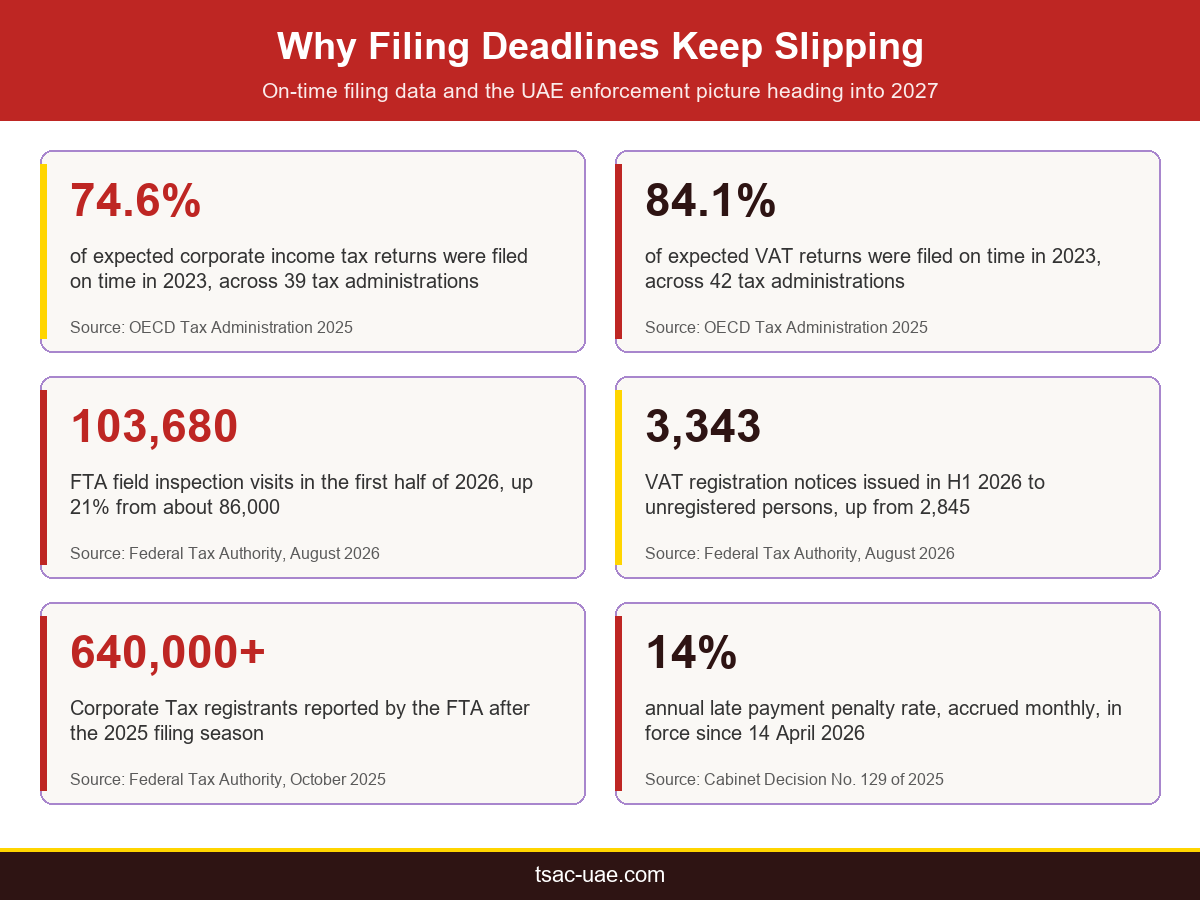
Across 39 tax administrations tracked in the
OECD Tax Administration 2025 report, only 74.6 percent of expected corporate income tax returns arrived on time in 2023. VAT returns did a little better
at 84.1 percent, which still means roughly one return in six was late or missing. UAE businesses face the same risk as
the year closes, because VAT return filing UAE 2027 obligations, corporate tax dates and a one time refund cut-off all
land within a few weeks. If you are unsure which dates apply to you,
speak with the TSAC advisory team before December gets
busy. This guide maps the deadlines businesses most often miss and how to stay ahead of each one.
Key Takeaways
-
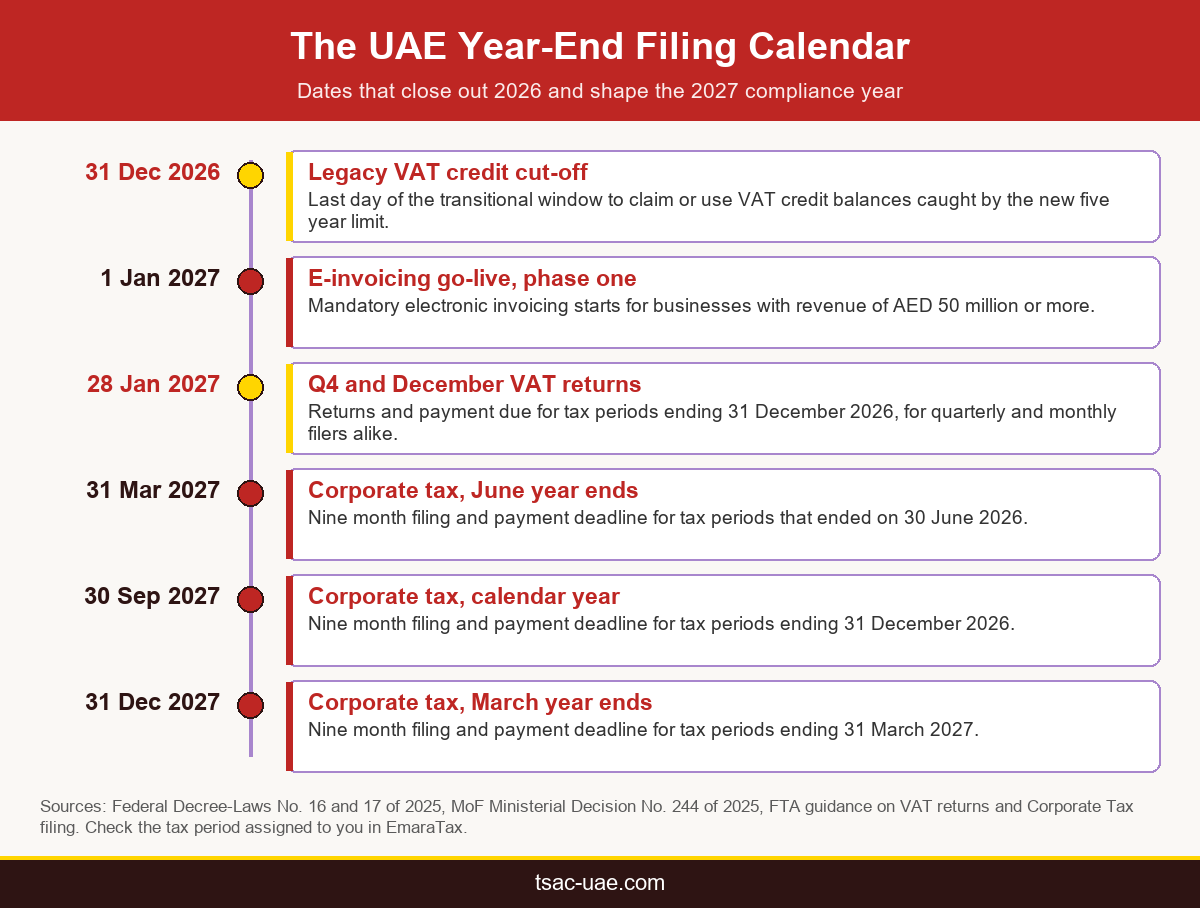
Legacy VAT credit balances caught by the new five year limit must be claimed or used by 31 December 2026, or they
may be lost for good. -
For VAT return filing UAE 2027, the first big date is 28 January 2027, when returns and payment for tax periods
ending 31 December 2026 fall due. -
The corporate tax return deadline Q4 UAE 2027 depends on your financial year end: nine months after it, so a 31
March 2027 year end must file by 31 December 2027.
The Refund Cut-Off That Closes on 31 December 2026
In short: from 1 January 2026, excess input tax can only be refunded or carried forward within five
years of the tax period it relates to. A transitional window lets businesses rescue older balances, but that window
closes on 31 December 2026. It is easy to overlook when credits have simply rolled forward from return to return.
Federal Decree-Laws No. 16 and No. 17 of 2025 amended the VAT Law and the Tax Procedures Law with effect from 1
January 2026. As
Baker McKenzie’s UAE tax team explains, businesses whose five year period had already expired, or will expire within one year after 1 January 2026, have
until 31 December 2026 to file pending refund requests.
This matters most for exporters, businesses in a long building or fit out phase and companies that routinely sit in a
refund position. A credit that has rolled forward quietly on every return since 2018 can now simply expire. The FTA
may also audit a refund claim within two years of the request, so the claim needs clean support. Our
VAT refund support starts with a reconciliation of every carried
forward balance, and our earlier piece on the
2026 refund deadline sets out
the background.
January Returns: The 28 Day Rule Still Catches People Out
In short: VAT returns and payment are due within 28 days of the end of each tax period. For quarterly
and monthly filers whose period ends on 31 December 2026, that means 28 January 2027. Holiday leave, year end closing
and audit work all compete for the same January weeks.
According to the
UAE government’s VAT filing guidance, taxable businesses usually file within 28 days of the end of the tax period. Businesses with annual turnover below
AED 150 million normally file quarterly, while those at AED 150 million or more file monthly. The authority can also
assign different periods, so your quarter may not match the calendar. Always confirm the stagger shown in your
EmaraTax account.
The cost of slipping has changed. Cabinet Decision No. 129 of 2025, which the
Federal Tax Authority confirmed came into force
on 14 April 2026, replaced the old compounding late payment penalties with an annual rate of 14 percent, accrued
monthly on unpaid tax. Incorrect returns now attract AED 500 for a first violation and AED 2,000 for a repeat, while
voluntary disclosures carry 1 percent per month on the tax difference.
Good VAT return filing UAE 2027 practice therefore means filing early, correcting errors through a disclosure rather
than waiting for an audit and paying on time. Our
VAT filing service builds this into a fixed monthly
or quarterly routine.
Corporate Tax: Your Deadline Follows Your Year End
In short: corporate tax returns and payment are due nine months after the end of each tax period. A
calendar year business files by 30 September 2027 for 2026. Companies with a March year end face the corporate tax
return deadline Q4 UAE 2027 instead, on 31 December 2027.
In its
September 2026 filing reminder, the FTA restated the nine month rule and stressed that businesses claiming Small Business Relief must still
register, file simplified returns and keep supporting records. Exempt persons required to register must also file an
annual declaration within nine months.
A common mistake is copying a date from the news. A company with a 30 June 2026 year end has until 31 March 2027, not
September. The FTA also listed the records it expects behind every return: a transaction record, an asset register, a
record of liabilities and a record of shares or ownership interests at the period end. Our
corporate tax return support maps each entity’s
own window and the records that go with it.
The pool of filers is large. The FTA
reported more than 640,000 Corporate Tax registrants
after the 2025 filing season, so a filing date that slips is unlikely to go unnoticed. Missing the corporate tax
return deadline Q4 UAE 2027 is avoidable, but only with a calendar built around your own year end.
Why Enforcement Makes 2027 Different
In short: the FTA is checking more, and invoice data will soon reach it far sooner. Field inspections
rose sharply in 2026, VAT registration notices increased and electronic invoicing begins on 1 January 2027 for the
largest businesses. Gaps between returns and transactions will be easier to spot.
According to the
FTA’s first half 2026 compliance update, the authority conducted about 103,680 field inspection visits in the first half of 2026, a 21 percent increase on
the same period in 2025, and issued 3,343 registration notices to persons who were not registered for VAT, up from
2,845. From 1 January 2027, businesses with revenue of AED 50 million or more must issue electronic invoices, with
smaller businesses following on 1 July 2027. Our overview of the
e-invoicing rules covers the phases.
As a forward looking point, this suggests that late or inconsistent returns in 2027 will surface sooner than they did
in the first years of corporate tax. Reconciled books matter more than ever, and reliable
bookkeeping and accounting support is the
foundation for both VAT and corporate tax filings.
A Simple Year-End Filing Plan
In short: a short plan made in November prevents most January and September surprises. List every
deadline, assign an owner and fix the data before the year closes. A local adviser who owns the calendar removes the
guesswork.
Start with four steps. First, confirm each entity’s VAT tax period and financial year end in EmaraTax. Second, review
every VAT credit balance relating to tax periods that ended in 2021 or earlier before 31 December 2026. Third, close
December books early enough to file by 28 January 2027. Fourth, book audit and corporate tax work around your own nine
month window. Keep a single shared calendar that shows every entity, every tax type and the person responsible, and
review it at each month end. When a return is filed, store the acknowledgement and the working papers together,
because those are what a reviewer will ask to see.
Many owners only start searching for a tax consultant near me for year end filing Dubai in the middle of January, when
advisers are already stretched. Starting in November gives time to fix records rather than rush them. If an audit is
part of your year end, our audit services can be
scheduled alongside the tax work.
Conclusion
The deadlines businesses keep missing are rarely obscure. They are the 31 December 2026 refund cut-off, the 28 January
2027 VAT returns and a corporate tax date that follows each company’s own year end. With penalties now accruing
monthly and FTA checks rising, VAT return filing UAE 2027 rewards preparation, not speed. If you want a tax consultant
near me for year end filing Dubai teams can rely on,
book a free consultation with TSAC and leave with a clear
year end calendar.