

Before you sign a share purchase agreement, due diligence companies in Dubai test whether the business is what the seller says it is. Investors who skip that step often discover hidden tax bills, weak contracts or inflated earnings after the money has moved. This guide explains what a buyer actually checks across finance, tax and legal risk. It also shows how providers scope the work and how to pick one. If you are preparing a deal now, our transaction support team can help you frame the questions early.
Key Takeaways
- Buy side due diligence tests earnings quality, tax exposure and contract risk before you commit capital.
- Corporate tax and VAT history now sit at the centre of every UAE review.
- A clear scope, timeline and red flag report matter more than a thick file.
What Do Investors Check in Financial Due Diligence in the UAE?
Financial due diligence in the UAE asks one core question: are the reported profits real and repeatable? Reviewers rebuild earnings from the ledgers, strip out one off items and test working capital. They also trace cash into the bank so that the price you pay rests on numbers you can rely on.
The starting point is a quality of earnings review. The team adjusts reported profit for owner salaries, related party charges and unusual income. A business that looks profitable on paper may carry costs that sit in a sister company. Those adjustments often move the price more than any other finding. Experienced due diligence companies in Dubai also compare management accounts with audited figures to spot gaps.
Next comes working capital and net debt. Buyers check receivables ageing, slow stock and supplier balances that the seller has stretched before the sale. They also look for debt like items, such as end of service gratuity provisions and unpaid bonuses. Each one reduces what the equity is truly worth, so it belongs in the price discussion from day one.
Due diligence is not valuation, but the two connect. Diligence tells you what is true today, while valuation prices the future. If you also need a price view, read our guide to valuing a UAE company alongside the diligence findings.
How Does Tax Due Diligence Cover Corporate Tax and VAT Exposure?
Tax due diligence checks whether the target has filed, paid and documented its UAE taxes correctly. In a share deal, past liabilities stay with the company you buy. Reviewers therefore test corporate tax registration, returns and free zone claims, then VAT filings and invoicing, and they quantify any exposure before signing.
Corporate tax applies to financial years starting on or after 1 June 2023. Taxable income above AED 375,000 is taxed at 9 percent, according to the UAE government’s corporate tax overview. Reviewers confirm the target registered on time, filed its returns and treated related party pricing on an arm’s length basis. Free zone companies get extra scrutiny on whether income really qualifies for the 0 percent rate.
VAT review covers registration, return accuracy, input tax recovery and invoice format. Reviewers sample transactions and compare filings with the ledger. They also check readiness for the electronic invoicing rollout. A target that has never faced an authority review may still carry errors. The FTA audit checklist is a useful benchmark.
Records matter as much as returns. Corporate tax rules require businesses to keep supporting records for seven years after the end of the tax period. A target with missing contracts or invoices cannot defend its positions. Where exposure is unclear, a corporate tax impact review puts a number on it.
Which Legal and Commercial Red Flags Can Stop a Deal?
Legal and commercial checks confirm that the company owns what it claims and that its revenue will survive the change of ownership. Reviewers read licences, shareholder records, key contracts and employment terms. They look for change of control clauses, customer concentration and disputes that could cut value or block completion.
Ownership comes first. Reviewers confirm the trade licence, the shareholder register and any nominee arrangements. They check that the licence covers the activities the business actually runs. A mismatch between licence and activity can create penalties or restrict how you operate after closing.
Contracts carry hidden risk. Many supply and customer agreements let the other party terminate on a change of control. If one client drives a large share of revenue, losing that contract can reshape the deal. Reviewers also read leases, guarantees and any loans from shareholders, since shareholder loan treatment affects both tax and net debt.
People and disputes close the list. Reviewers check employment contracts, visa sponsorship and end of service obligations. They also search for court cases, cheque claims and regulatory notices. Each finding goes into the red flag report with a suggested fix, such as a price cut, an indemnity or a condition before completion.
How Do Due Diligence Companies in Dubai Scope and Deliver the Work?
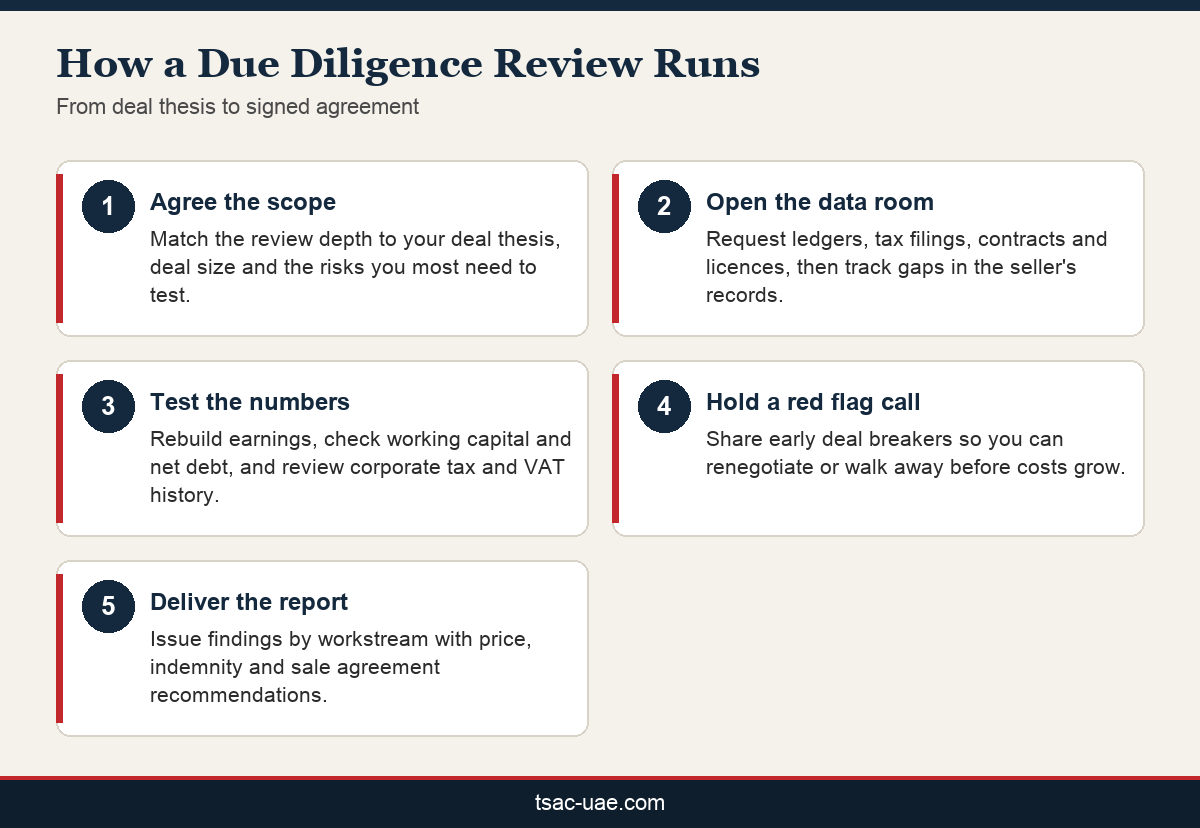
Good due diligence companies in Dubai agree the scope before they open the data room. They match the depth of review to deal size and risk and set a timeline that fits the signing date. Findings then arrive in a format your lawyers and bankers can use. A tight scope keeps fees and delays under control.
Scope starts with your deal thesis. A buyer paying for recurring revenue needs deep customer and contract work. A buyer acquiring assets cares more about title and condition. The provider should propose a scope that explains what is in, what is out and why. Compare proposals from two or three due diligence companies in Dubai on that clarity, not on page count.
Timelines depend on how ready the seller is. A well organised data room shortens the work, while missing ledgers stretch it. Most providers run the review in phases, with an early red flag call before the full report. That call lets you renegotiate or walk away before costs grow.
Deliverables should be practical. Expect a red flag summary, a detailed report by workstream and a list of items for the sale agreement. The best reports separate deal breakers from points you can fix with price or warranties. They also give your lawyers precise wording for warranties and indemnities, which saves time in the final negotiation.
How Should You Choose a Due Diligence Provider in the UAE?
Choosing among due diligence companies in Dubai is about fit, not size. You need a team that understands UAE tax law, reads local contracts and can work to your deal timetable. Ask how they handle corporate tax and VAT, who will do the work, and how findings will feed into price and the sale agreement.
Start with sector and deal experience. Ask for the type of transactions the team has supported, without expecting client names. Then ask who will run the review day to day. A senior name on the proposal means little if a junior team does the work.
Check how the provider links findings to action. Buy side due diligence is only useful if it changes price, structure or protection. Strong teams translate each issue into a number or a clause. Weak teams list problems and leave you to decide what they mean. Ask to see a sample red flag summary before you appoint anyone.
Finally, test independence and clarity on fees. A fixed fee for an agreed scope avoids surprises. Ask how out of scope requests are priced. Independence matters too, so avoid a provider that also advises the seller on the same deal.
Conclusion
A deal is only as safe as the review behind it. The right due diligence companies in Dubai test earnings, tax exposure and contract risk, then turn each finding into price or protection. That work is more important now that corporate tax and electronic invoicing add new layers of exposure to every UAE target. TSAC, founded in 2020, supports buyers and investors with financial and tax due diligence from offices in Dubai and Sharjah. To scope a review for your next transaction, book a free consultation with our advisory team.
Frequently Asked Questions
What do due diligence companies in Dubai review before a deal?
They review financial statements, earnings quality, working capital, corporate tax and VAT compliance, licences, contracts and disputes. The aim is to confirm that the business matches the seller’s claims and to quantify any risk before you sign.
How long does financial due diligence in the UAE take?
Timing depends on deal size and how organised the seller’s records are. A focused review of a small company moves faster than a full review of a group. Ask your provider for a phased plan with an early red flag call.
What is buy side due diligence?
Buy side due diligence is the review a buyer or investor commissions before acquiring a business. It tests whether profits, assets and tax positions are reliable. The findings shape the price, the deal structure and the protections in the sale agreement.
Why does corporate tax matter in a UAE acquisition?
In a share purchase, past tax liabilities stay with the company you buy. If the target missed registration, filed incorrect returns or claimed free zone benefits wrongly, you inherit that exposure. Tax due diligence finds and prices these risks before completion.
Is due diligence the same as a business valuation?
No. Due diligence checks whether the information about a business is accurate and complete. Valuation estimates what the business is worth. Investors often use both, with diligence findings feeding adjustments into the valuation and the final price.
Can due diligence uncover problems with past audits?
Yes. Reviewers read the audited accounts and the auditor’s notes, then test key balances against ledgers and bank records. Where gaps appear, our statutory audit team can help a buyer understand what the accounts do and do not prove.
Do related party transactions affect a deal review?
They do. Related party charges can inflate or hide profit, and UAE corporate tax expects arm’s length pricing. Reviewers test these arrangements and their documentation. Where pricing looks weak, transfer pricing support helps assess the exposure.
What should the final due diligence report include?
Expect a red flag summary, detailed findings by workstream and a list of issues for the sale agreement. Each finding should state its likely impact and a suggested response, such as a price adjustment, an indemnity or a condition.