
Choosing between an in house accountant and an accounting service provider is one of the first finance decisions a growing UAE SME faces. The salary is only the visible part of the cost; an accounting service provider is often compared against a payslip, not against the full cost of employment. This guide builds that full cost, line by line, using indicative AED ranges. It then adds the compliance load from corporate tax, VAT and e-invoicing, and shows where outsourced bookkeeping and reporting wins, loses or works best as a hybrid.
Key Takeaways
- An in house accountant costs well beyond salary once visa, insurance, gratuity, software and leave cover are added.
- An accounting service provider usually charges a fixed monthly fee that scales with transaction volume and compliance scope.
- Corporate tax, VAT and the 2027 e-invoicing rollout raise the skill bar, which often tilts small teams toward outsourcing or a hybrid model.
What Does an In House Accountant Really Cost a UAE SME?
An in house accountant costs far more than the monthly salary. Employers in the UAE also pay for the residence visa, Emirates ID, mandatory health insurance, end of service gratuity, accounting software, training and cover during annual leave. Added together, these items commonly push the true annual cost well above twelve months of salary.
Start with salary. As an indicative range, a qualified mid level accountant in Dubai often earns between AED 7,000 and AED 15,000 a month, depending on experience and certifications. A junior bookkeeper costs less, while a finance manager with corporate tax exposure costs considerably more.
Next come employment costs. A residence visa cycle, with medical test, Emirates ID and labour fees, typically runs into a few thousand dirhams per employee. Dubai requires employers to fund health insurance, with basic plans starting at several hundred dirhams a year and enhanced cover costing more.
Gratuity is the cost most owners forget. Under the official end of service rules, a worker earns 21 days of basic pay for each of the first five years. Add software licences, training, and cover for 30 days of annual leave. Leave cover matters because returns and payroll do not pause while your only accountant is away. Many owners end up paying a temporary contractor or asking a manager to step in, which carries its own hidden cost.
What Does an Accounting Service Provider Charge?
An accounting service provider usually charges a fixed monthly or quarterly fee based on transaction volume, the number of bank accounts, payroll size and compliance scope. There is no visa, gratuity or leave cover to fund. The fee covers a team rather than one person, which removes the single point of failure.
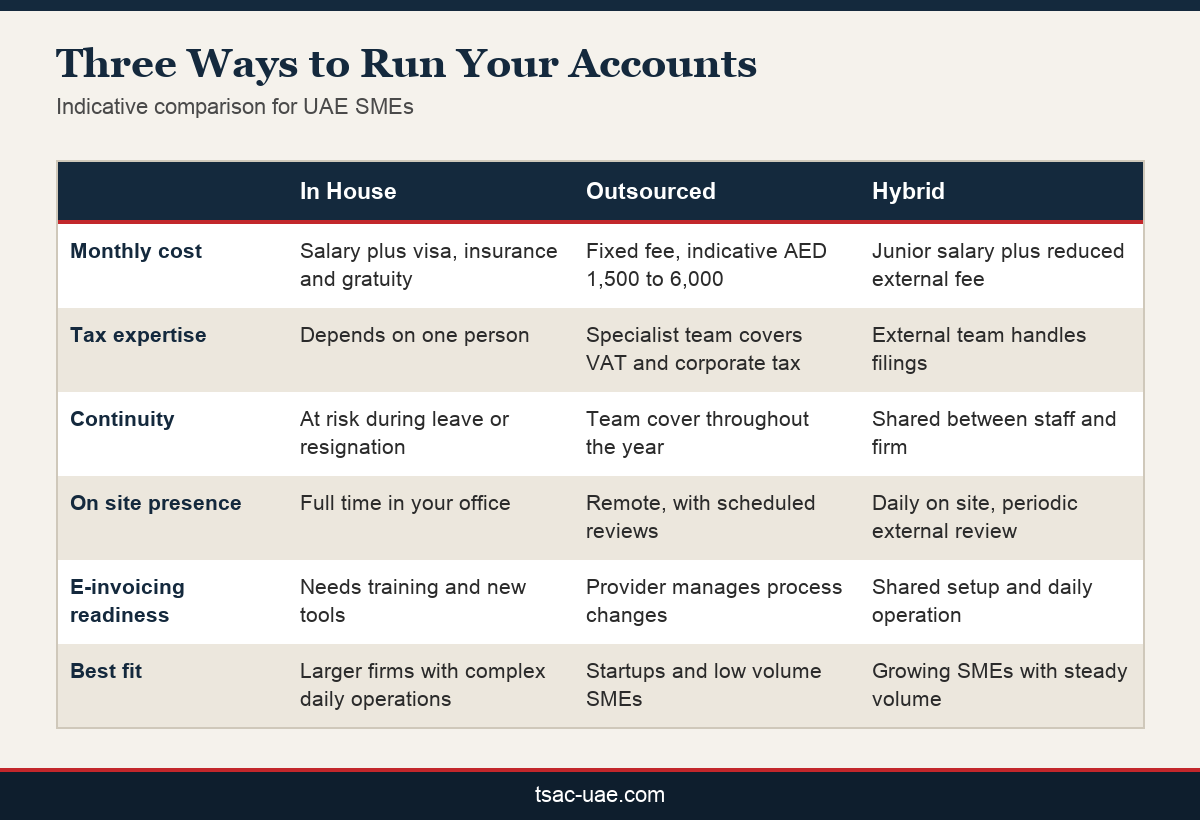
As an indicative range, outsourced accounting in the UAE for a small trading or services company often costs AED 1,500 to AED 6,000 a month. Low volume startups sit at the bottom of that band. Businesses with inventory, several entities or heavy payroll sit at the top.
Scope drives price more than headcount. A basic package covers bookkeeping, bank reconciliations and monthly management accounts. A fuller package adds VAT returns, corporate tax computation, audit support and advisory time. Always compare packages on the same scope, not on the headline fee.
The hidden value is continuity. Your books keep moving when someone resigns, falls ill or travels. Strong record keeping also matters, because FTA Decision 4 of 2026 on record keeping expects complete, retrievable records that a provider maintains by default. A good provider also documents its processes, so a new reviewer can pick up your file quickly.
How Do Corporate Tax, VAT and E-Invoicing Change the Maths?
Compliance has become the deciding factor. Corporate tax returns, VAT filings and the move to mandatory e-invoicing demand technical knowledge that one generalist accountant may not hold. When a single mistake can trigger penalties, the cost of current expertise matters more than the cost of headcount for most UAE SMEs.
Corporate tax added an annual return, transfer pricing awareness and a demand for accurate financial statements. Many SMEs that relied on a bookkeeper now need corporate tax return support from specialists who follow each new decision and FTA guide. Those rules keep changing, so knowledge must be refreshed every year.
VAT adds monthly or quarterly deadlines, with penalties for late or incorrect filings. Reliable return preparation and filing depends on clean books every period, not a scramble at quarter end. A single in house hire must manage both regimes alone. Holiday periods and staff turnover make that harder still.
E-invoicing raises the bar again. Under the phased rollout, larger businesses go live from January 2027 and others follow later in 2027. The Ministry of Finance e-invoicing page sets out the framework. Each business must appoint an accredited service provider and adapt its invoicing process. That means new software, cleaner master data and staff training. For an in house team of one, this is a sizeable project on top of routine work, while an accounting service provider can spread the setup effort across many clients.
Is a Hybrid Model the Right Middle Ground?
A hybrid model keeps a junior accountant or administrator in house for daily entries and supplier queries, while an external firm handles review, tax filings, reporting and year end work. It suits growing SMEs that want someone on site but cannot yet justify a senior finance hire with full tax knowledge.
In practice, the in house person records invoices, chases receipts and handles petty cash. The external team reviews the ledger monthly, prepares VAT and corporate tax filings and produces management accounts. Owners get daily responsiveness without paying senior salaries. The junior hire also costs less in gratuity and insurance than a senior one.
The hybrid also eases the move to e-invoicing. Your staff member manages the daily invoice flow, while specialists configure the process and check compliance. Our earlier piece on how outsourcing fits e-invoicing covers that integration in more detail.
Watch for gaps in responsibility. Agree in writing who owns each task, deadline and approval. A clear scope letter keeps the arrangement efficient and stops errors falling between the two teams. Set a monthly close date, a shared document folder and a named contact on each side. Review the split every quarter during the first year, then adjust duties as your volume grows.
How Should You Decide Between the Three Models?
Base the decision on transaction volume, compliance complexity and the need for someone on site. Very small businesses usually save by outsourcing fully. Mid sized SMEs with steady volume often prefer a hybrid. Only larger companies with complex daily operations typically justify a full in house finance team of their own.
Build a simple annual comparison. Add salary, visa, insurance, a gratuity accrual, software and leave cover for the in house option. Set that against twelve months of an accounting service provider fee for the same scope. On a basic salary of AED 6,000, the gratuity accrual alone is roughly AED 4,000 a year.
Then weigh risk, not just cost. Ask who covers resignations, who tracks new FTA rules, and who will answer an audit query. An accounting firm for SME clients spreads that knowledge across a team. Also consider how quickly you can scale. Adding scope with an accounting service provider is usually a contract change, while adding staff means another hiring cycle, visa and probation period.
Finally, review the choice yearly. Growth, new entities or the e-invoicing deadline may shift the balance. A model that suited you at launch may not suit you two years later. Run the comparison again whenever revenue, headcount or regulation changes materially, and keep the workings so you can see how the numbers moved.
Conclusion
There is no single right answer, but there is a right method. Cost every line of an in house hire, compare it with an accounting service provider on equal scope, and then factor in corporate tax, VAT and e-invoicing risk. For many UAE SMEs, full outsourcing or a hybrid model delivers better control at a lower total cost. If you want a tailored comparison for your business, book a free consultation with TSAC and we will map your options clearly.
Frequently Asked Questions
How much does an accounting service provider cost in the UAE?
As an indicative range, small UAE businesses often pay AED 1,500 to AED 6,000 a month. The fee depends on transaction volume, payroll, entities and whether VAT, corporate tax and audit support are included in the agreed scope.
What is the true cost of an in house accountant in Dubai?
Beyond salary, budget for the residence visa, Emirates ID, mandatory health insurance, gratuity, software, training and leave cover. Together these items commonly push the annual cost well above twelve months of salary for one employee.
How is end of service gratuity calculated for an accountant?
UAE Labour Law grants 21 days of basic salary for each of the first five years, then 30 days for each further year. The total cannot exceed two years of wages, and service under one year earns nothing.
Does outsourcing remove my compliance responsibility?
No. The business remains legally responsible for its tax filings and records. Outsourcing transfers the work to specialists, which reduces the risk of errors, but owners should still review and approve every return before it is submitted.
Is outsourced accounting suitable for a startup?
Yes, in most cases. Startups rarely have enough volume to keep a full time accountant busy. Outsourcing gives them bookkeeping, VAT and corporate tax support for a predictable monthly fee without visa or gratuity costs.
What does a hybrid accounting model look like?
A junior staff member handles daily entries, receipts and supplier queries in house. An external team reviews the books, files VAT and corporate tax returns and prepares management accounts. Both sides work from an agreed written scope.
Will e-invoicing affect which model I choose?
It can. E-invoicing requires an accredited service provider, process changes and clean master data. Teams without technical depth often find outsourcing or a hybrid easier to manage than retraining a single in house accountant under deadline pressure.
Can the same firm handle both accounting and audit?
Independence rules stop a firm from auditing books it prepared itself. Many SMEs use one firm for accounting and another for the statutory audit. You can learn more about our audit team and about TSAC.