
Every UAE free zone company, whether it will eventually qualify for the 0 percent rate or not, must complete
the EmaraTax registration process that authorities now
treat as a standard compliance step. Missing the deadline or filing incomplete details on EmaraTax delays your Tax
Registration Number and puts every filing after it at risk. This guide walks you through the EmaraTax free zone
registration process from start to finish, the documents to prepare in advance, and the mistakes that most often slow
free zone companies down.
Key Takeaways
-
Every free zone entity must register for corporate tax on EmaraTax, whether or not it later claims Qualifying Free
Zone Person status. -
Registration errors such as mismatched licence details, incomplete ownership information, or missing documents are
the leading cause of delayed Tax Registration Number issuance. -
A dedicated point of contact who tracks your registration status on a live dashboard catches problems before the
Federal Tax Authority does.
Why Free Zone Corporate Tax Registration Works Differently
The UAE introduced federal corporate tax with a distinct regime for free zone businesses, and that distinction causes
confusion at the registration stage. Free zone companies often assume that because they may ultimately pay 0 percent
tax on qualifying income, registration is optional or can wait. It is not. The
Federal Tax Authority requires
every taxable person, including free zone entities, to register and obtain a Tax Registration Number regardless of the
rate that will eventually apply to their income.
Registration and the Qualifying Free Zone Person election are two separate processes. You register your entity first,
and only afterward does your ongoing compliance record determine whether you keep access to the preferential rate.
Businesses that treat free zone corporate tax registration as a single event, rather than the start of an ongoing
relationship with the FTA, tend to underinvest in the
corporate tax services that keep them compliant
afterward. For a broader view of how the framework applies across the UAE, our overview of
UAE corporate tax key highlights is a useful
starting point before you begin the registration process itself.
Step-by-Step: How to Register on EmaraTax as a Free Zone Entity
EmaraTax free zone registration follows the same platform as mainland registration, but a handful of fields are
specific to free zone entities and easy to complete incorrectly. The infographic below breaks the process into five
stages, from confirming your entity details through to Tax Registration Number issuance.
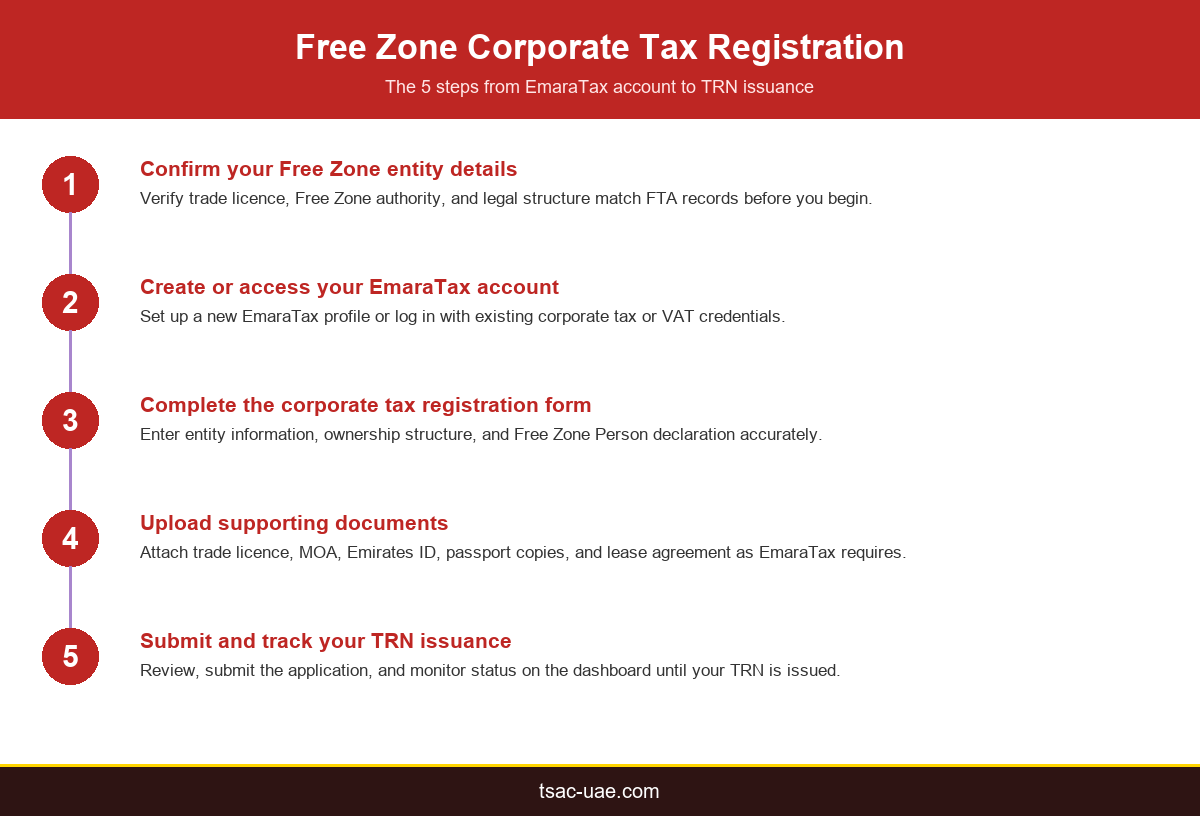
Start by confirming that your trade licence, free zone authority, and legal structure are recorded consistently across
every government system your company touches. Inconsistencies between your
business incorporation documents and what
EmaraTax expects are one of the most common reasons applications stall at review. Once your details are confirmed,
create your EmaraTax account, or log in if you already hold credentials from VAT registration, and select the
corporate tax registration pathway for a Free Zone Person.
The registration form asks for ownership structure, licensed activities, and a declaration of your free zone status.
Read each field against your actual licence rather than relying on memory. Our guide on
how registration shapes your filing calendar
explains why accuracy at this stage affects everything from your filing calendar to your eligibility for the
qualifying income rate later. After submission, EmaraTax issues an application reference number, and your
Tax Registration Number typically
follows once the FTA completes its review.
Documents and Information You Need Before You Start
Gathering documents after you start the application is the single biggest cause of avoidable delay. The checklist
below covers what most free zone entities need on hand before opening EmaraTax, though your specific free zone
authority may request additional items.
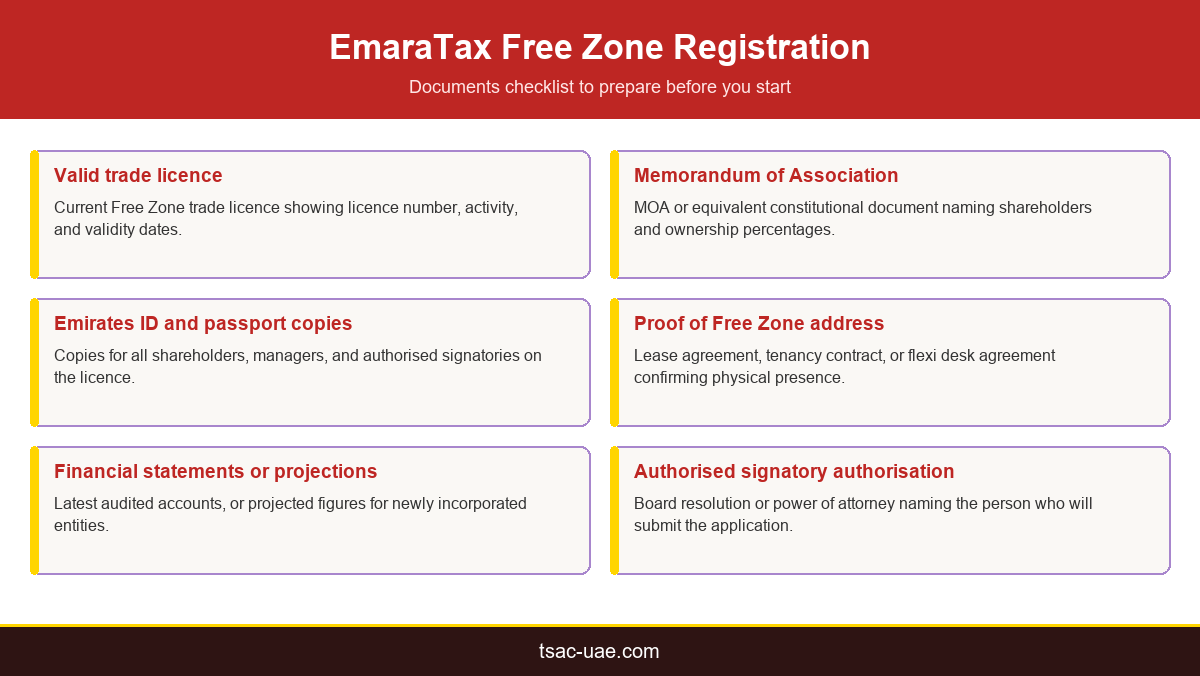
Beyond the trade licence and constitutional documents, free zone companies should have their most recent
accounting records organised, since EmaraTax may
request financial information to support your registration. If your entity has already undergone an
audit, keep those statements accessible too. Any
change to your licence details, shareholders, or registered address after you submit must be reflected promptly. The
FTA’s
grace period to update information in tax records
gives you a window to correct records, but it is far simpler to get the details right the first time.
Common Registration Mistakes Free Zone Companies Make, and How to Avoid Them
Most registration problems trace back to a small set of recurring mistakes: submitting before licence renewal
paperwork is finalised, listing an authorised signatory whose authority has since changed, or declaring activities
that no longer match what the free zone licence actually permits. Our review of
the penalties for skipping this step
sets out the penalties that follow a missed or rejected registration, and they apply to free zone entities just as
they do to mainland companies.
This is where TSAC’s approach differs from a generic filing service. Instead of a one-time submission and no further
contact, every free zone client is assigned a dedicated point of contact who tracks your registration status on a live
dashboard, flags missing information before the FTA does, and confirms your Tax Registration Number the moment it is
issued. That model exists because corporate tax registration is rarely the end of the compliance relationship. It is
the start of one, and clients tell us the ongoing visibility matters as much as the initial filing. You can read how
that has worked for other UAE businesses on our testimonials page, or
see the wider team behind it on our About page.
What Happens After You Register: Staying Compliant Year-Round
Receiving your Tax Registration Number closes the registration stage but opens the compliance calendar. Free zone
entities must file corporate tax returns, maintain audited financial statements where required, and, if applicable,
manage VAT obligations alongside corporate tax. Many
free zone companies also carry
Economic Substance Regulations obligations that
run in parallel with corporate tax compliance, and treating them as separate workstreams often creates duplicated
effort.
As the regime matures, the FTA has increasingly focused on second and third year filings rather than first
registrations. Our guide to
tax consulting in year two of corporate tax
covers what changes once the initial registration period is behind you. Free zone companies that also issue invoices
at scale should review our e-invoicing guidance
now, since the UAE’s e-invoicing mandate will affect how qualifying and non-qualifying income is documented going
forward. For a full picture of ongoing obligations, our
corporate tax compliance guide
is a useful companion to this registration walkthrough.
For the FTA’s own explanation of how free zone corporate tax registration and the qualifying regime fit together, its
Corporate Tax guide on Free Zone Persons
sets out the underlying conditions in full, and the
Ministry of Finance corporate tax overview provides useful policy
context if your board or shareholders want the source material alongside this practical guide.
Conclusion
Free zone corporate tax registration is straightforward on paper, but the details, licence consistency, accurate
declarations, and complete documentation determine whether your Tax Registration Number arrives on schedule or gets
delayed by avoidable back and forth. Getting it right the first time also sets up a cleaner path toward Qualifying
Free Zone Person status later. If you want a dedicated point of contact tracking your registration from application to
TRN, book a free consultation with TSAC’s corporate tax
team and start with a strategy built around your free zone structure, not a generic checklist.
Frequently Asked Questions
How long does free zone corporate tax registration take on EmaraTax?
Processing times vary, but most complete applications with accurate documentation are reviewed within 20 business
days. Missing or inconsistent information extends this significantly, which is why document preparation matters as
much as the application itself.
Does registering for corporate tax mean my free zone company will pay 9 percent tax?
No. Registration and rate determination are separate. Registering gives you a Tax Registration Number. Whether
qualifying income is taxed at 0 percent depends on meeting Qualifying Free Zone Person conditions on an ongoing basis,
covered in our advisory guide.
Can I register for free zone corporate tax before my trade licence renews?
You can register on EmaraTax with a valid, unexpired licence. If renewal is pending, most businesses wait until the
new licence is issued to avoid a mismatch between application details and licence records.
What is the deadline for free zone company tax registration in the UAE?
Deadlines are tied to licence issuance date under FTA Decision 3 of 2024. Missing your assigned window triggers
penalties, detailed in our guide on avoiding penalties in UAE tax compliance.
Do free zone branches of mainland companies register separately?
Generally yes. A free zone branch is typically registered and assessed based on its own licence and activities, though
the correct treatment depends on the branch’s legal structure and should be confirmed with an advisor before
submission.
What documents does EmaraTax ask for during free zone registration?
Expect requests for your trade licence, Memorandum of Association, Emirates ID and passport copies for shareholders
and signatories, proof of your free zone address, and recent financial information.
Can I amend my free zone corporate tax registration after submission?
Yes, through EmaraTax’s amendment function, though changes to core details such as ownership or activities should be
made promptly. Our Dubai advisory guide covers how to keep records current after registration.
Does every free zone entity need its own Tax Registration Number?
Each licensed legal entity registers individually and receives its own Tax Registration Number, even if a group
operates across multiple free zones or holds several licences under common ownership.
What happens if my free zone corporate tax registration is rejected?
The FTA typically issues a rejection reason through EmaraTax, and you can resubmit with corrected information.
Repeated rejections delay your Tax Registration Number, so review our FAQs page or speak with an advisor before
resubmitting.
Is free zone corporate tax registration different from VAT registration on EmaraTax?
Yes. They are separate registrations on the same platform, each with its own thresholds, documentation, and Tax
Registration Number, though existing VAT credentials can be used to access EmaraTax for corporate tax registration
too.