
For a Qualifying Free Zone Person, the gap between paying 0 percent corporate tax and paying 9 percent on every dirham of income can come down to a single ratio. The de minimis requirement uae corporate tax rule sets a hard cap on how much non-qualifying revenue a Free Zone entity can earn before it loses its preferential status for five full tax periods. This guide breaks down how the threshold is calculated, what counts toward it, and how growing SMEs can track the ratio throughout the year instead of discovering a breach only after the accounts close.
Key Takeaways
- The de minimis rule free zone uae test caps non-qualifying revenue at the lower of AED 5,000,000 or 5 percent of a Free Zone Person’s total revenue in the tax period.
- Breaching the non-qualifying revenue threshold free zone strips Qualifying Free Zone Person status for the current tax period plus the following four, a five year clawback that pulls the standard 9 percent rate onto all income, not just the excess.
- Continuous monitoring, backed by a dedicated point of contact and dashboard reporting rather than a once a year review, is the most reliable way for SMEs to pass the qfzp de minimis test every period.
What Is the De Minimis Requirement Under UAE Corporate Tax Law?
The de minimis requirement is one of the conditions a Free Zone entity must satisfy to keep its status as a Qualifying Free Zone Person under Federal Decree-Law No. 47 of 2022 and Ministerial Decision No. 265 of 2023. Meeting it is what allows a business to apply the 0 percent rate to its Qualifying Income instead of the standard 9 percent rate that applies to mainland entities and non-qualifying Free Zone Persons alike.
Alongside the de minimis test, a Free Zone Person must also maintain adequate substance, earn Qualifying Income, and keep audited financial statements. Our corporate tax services team walks new and existing Free Zone clients through every condition together, because the de minimis calculation only makes sense once the other qualifying criteria are already confirmed. For a broader refresher on how the regime fits together, see our guide to UAE corporate tax key highlights.
What Counts as Non-Qualifying Revenue?
Non-qualifying revenue is any income that falls outside the categories of Qualifying Income defined in the Ministerial Decision. In practice, this usually includes revenue from excluded activities such as certain banking, insurance, or real estate transactions, plus revenue earned from transactions with mainland UAE persons that do not fall under a Qualifying Activity. A single large mainland contract can push an otherwise compliant Free Zone company over the free zone revenue threshold corporate tax limit without anyone noticing until the return is prepared.
Businesses that combine free zone trading with occasional mainland work, or that hold a mix of qualifying and excluded activities, face the highest risk here. Our team pairs the VAT services review with corporate tax classification so that every invoice is tagged correctly at source. This matters because the classification decisions made for VAT and for corporate tax do not always align, and a revenue stream that is standard rated for VAT can still be non-qualifying for corporate tax purposes. For more on how the filing mechanics work in practice, read our complete guide to annual returns.
How to Calculate and Monitor Your De Minimis Ratio
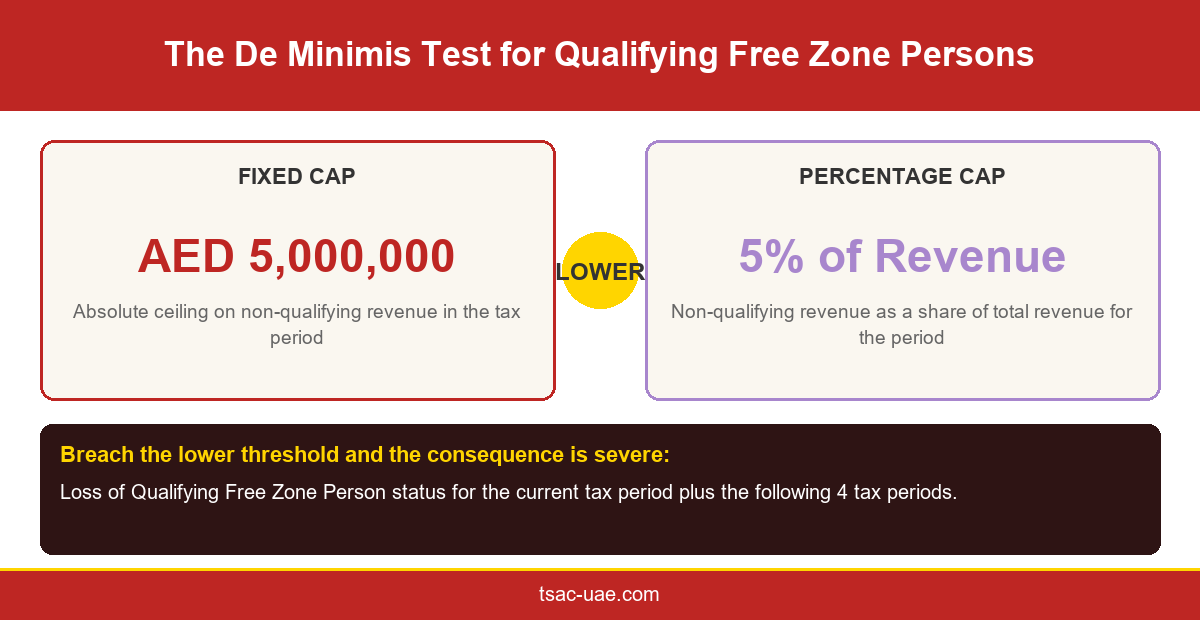
The calculation itself is straightforward once revenue is classified correctly. Take total non-qualifying revenue for the tax period and compare it against two figures: AED 5,000,000, and 5 percent of total revenue for the same period. Whichever of those two figures is lower becomes the cap that applies to your business.
Consider a Free Zone trading company with AED 40,000,000 in total annual revenue. Five percent of that figure is AED 2,000,000, which is lower than the AED 5,000,000 fixed cap, so AED 2,000,000 is the actual ceiling that applies. A larger company with AED 150,000,000 in total revenue would instead be capped at the fixed AED 5,000,000 figure, because 5 percent of AED 150,000,000 works out to AED 7,500,000, which is higher. This is why the ratio needs to be recalculated every period rather than assumed from the prior year.
Our accounting services team builds this ratio directly into monthly management accounts for Free Zone clients, so the figure is visible well before year end rather than reconstructed retroactively. Businesses that issue invoices through our electronic invoicing workflow benefit further, since qualifying and non-qualifying revenue can be tagged at the point of invoicing instead of reclassified later.
What Happens If You Breach the De Minimis Threshold
The consequence of failing the qfzp de minimis test is disproportionate to a single bad quarter. Under the Federal Tax Authority’s guide on Free Zone Persons, a Free Zone entity that exceeds the threshold loses Qualifying Free Zone Person status for the tax period in which the breach occurred, and for the four tax periods that follow. That is a five year clawback triggered by a single non-compliant period.
During that five year window, the standard 9 percent corporate tax rate applies to all of the entity’s income, not only the non-qualifying portion that caused the breach. A business that was otherwise earning clean Qualifying Income from genuine free zone trading loses the 0 percent benefit on that income too. Our article on the risks of ignoring corporate tax advisory covers several comparable scenarios where a small classification error produced a disproportionately large tax bill.
Because the clawback period is fixed and cannot be shortened through later good behaviour, prevention is the only real defence. Our guide to avoiding penalties in UAE tax compliance and our piece on how expert corporate tax services help avoid penalties both apply directly to de minimis exposure, since the underlying discipline of tracking revenue classification in real time is the same control that prevents most Free Zone corporate tax penalties.
Practical Monitoring for SMEs: A Dedicated Point of Contact and Dashboard Tracking
Large multinational Free Zone groups often have in house tax teams that can run this calculation quarterly. Most SMEs and mid market Free Zone businesses do not, and a dense technical summary produced once a year does little to prevent a breach that builds up gradually across twelve months of invoicing.
Our approach is built around a dedicated point of contact who owns your Free Zone compliance position and a live dashboard that tracks the qualifying versus non-qualifying revenue split as transactions happen, not after the fact. Instead of a single technical memo, clients get real time job tracking on every filing milestone and an early warning well before the ratio approaches the cap. This is the same team structure behind our audit services and transaction advisory work, so the same person who flags a de minimis risk can also advise on how to restructure a contract before it is signed.
This practical, implementation first approach is deliberately different from a dense technical summary. It is built for a business owner who needs to know what to do next, not just what the law says. Our take on why effective corporate tax planning is crucial for business success expands on why proactive tracking consistently outperforms reactive compliance for growing Free Zone companies.
What This Means for Your Business: Next Steps
If your Free Zone business earns any revenue outside its core qualifying activities, whether from mainland clients, excluded activities, or a new product line, treat the de minimis ratio as a monthly metric rather than a year end afterthought. A short internal checklist helps:
- Classify every revenue stream as qualifying or non-qualifying at the point of invoicing, not at filing time.
- Recalculate the ratio against both the AED 5,000,000 cap and the 5 percent cap every quarter, since the lower figure can change as revenue grows.
- Flag any new contract with a mainland UAE counterparty for review before it is signed, not after invoicing begins.
- Keep audited financial statements current, since the ratio and your wider Qualifying Free Zone Person status both depend on them.
Our corporate tax compliance services guide covers the wider set of conditions that sit alongside the de minimis rule, and our article on how corporate tax compliance influences a company’s reputation explains why lenders and investors increasingly ask Free Zone businesses to evidence exactly this kind of ongoing monitoring during due diligence.
Businesses that are still finalising their Free Zone structure should also review our business incorporation services and economic substance regulations pages, since substance and de minimis compliance are assessed together by the Federal Tax Authority.
Conclusion
The de minimis requirement is narrow in wording but wide in consequence. A single quarter of unmonitored non-qualifying revenue can cost a Free Zone business five years of the 0 percent rate it worked to secure. The businesses that avoid this outcome are the ones tracking the ratio continuously, with a dedicated point of contact and dashboard visibility rather than a once a year review. Our advisory guide explains how our team structures that ongoing support. To review your current Free Zone revenue mix against the threshold, book a free consultation with our tax advisory team.
Learn more about our track record on our about page or read what current clients say on our testimonials page.
Frequently Asked Questions
What is the de minimis requirement under UAE corporate tax?
It is the rule capping a Qualifying Free Zone Person’s non-qualifying revenue at the lower of AED 5,000,000 or 5 percent of total revenue in a tax period, under Federal Decree-Law No. 47 of 2022.
How is the de minimis rule free zone UAE threshold calculated?
Compare non-qualifying revenue against AED 5,000,000 and against 5 percent of total revenue for the same period. Whichever figure is lower becomes the applicable cap for that period.
What counts as non-qualifying revenue for a Free Zone Person?
Revenue from excluded activities and revenue from transactions with mainland UAE persons that fall outside a Qualifying Activity both count as non-qualifying revenue under the regime.
What happens if a Free Zone company fails the de minimis test?
It loses Qualifying Free Zone Person status for the current tax period and the following four tax periods, becoming subject to the standard 9 percent rate on all income during that time.
Does the de minimis threshold reset every year?
Yes. The ratio must be recalculated every tax period based on that period’s total revenue and non-qualifying revenue, since the lower of the two caps can shift as the business grows.
Can a Free Zone company recover its QFZP status before the five year period ends?
No. The clawback period is fixed once a breach occurs, which is why ongoing monitoring matters more than a corrective filing after the fact.
Does VAT classification affect the de minimis corporate tax calculation?
Not directly, but VAT and corporate tax classifications often diverge. A transaction can be standard rated for VAT while still counting as non-qualifying revenue for corporate tax.
How often should a Free Zone business review its de minimis ratio?
At least quarterly, and ideally continuously through management accounts, since a single large mainland contract can push the ratio over the threshold mid year.
Is the AED 5,000,000 cap fixed regardless of company size?
The AED 5,000,000 figure is fixed, but it only applies where it is lower than 5 percent of total revenue. Smaller businesses, where 5 percent of revenue comes to less than AED 5,000,000, are capped by the 5 percent test instead.
Who should review a Free Zone company’s revenue classification?
A qualified tax advisor should review classification alongside your registration position, since misclassification at registration often carries through to the de minimis calculation later. See also our note on the grace period for updating tax records if your activity mix has changed since registration.