

An online store in Dubai can look profitable on the sales dashboard and still lose money once fees, returns and VAT land. That gap is why the list of accounting and bookkeeping services for e-commerce and retail differs from a standard office business. Marketplace payouts arrive net, stock sits in several places, and cash, card and buy now pay later settlements all need matching. This guide sets out the services an online seller or retailer in the UAE actually needs, and where our tax support built for online sellers fits in.
Key Takeaways
- Record every marketplace sale at its gross price, then post commissions, fulfilment fees and refunds separately so VAT and margins stay accurate.
- Small Business Relief now runs to tax periods ending on or before 31 December 2029, but it must be elected and the AED 3 million test is strict.
- E-invoicing covers business to business sales first; most SMEs below AED 50 million go live on 1 July 2027.
What Is on the List of Accounting and Bookkeeping Services for Online Sellers?
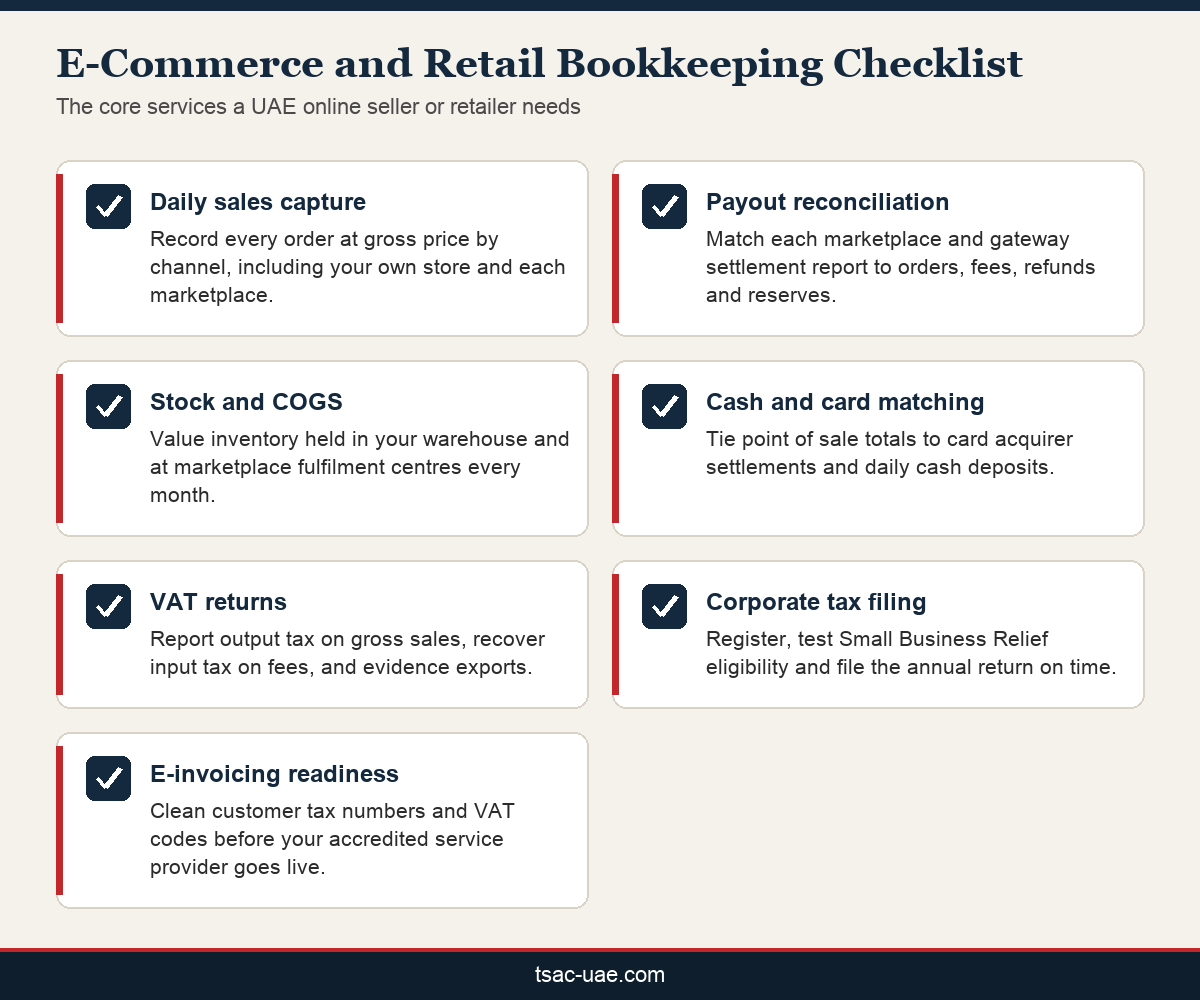
For an online seller or retailer, the list of accounting and bookkeeping services covers six areas. These are sales and payout reconciliation, inventory and cost of goods sold, VAT, cash and card settlement, corporate tax, and e-invoicing readiness. Each feeds the next, so a gap in daily bookkeeping surfaces later as a wrong VAT return or a misstated profit.
A service business mostly tracks invoices and expenses. A seller on Amazon.ae, Noon or its own Shopify store tracks thousands of small transactions, each with fees, shipping and possible returns. The bookkeeping has to translate that volume into clean monthly figures. It also has to cope with several currencies, couriers and cash on delivery collections.
In practice, the list of accounting and bookkeeping services we scope for retail clients starts with daily sales capture and weekly payout matching. It continues with monthly stock valuation, quarterly VAT returns and an annual corporate tax return. Management reports by channel come on top, so owners can see which marketplace actually earns money.
If you already read our general bookkeeping guide, think of this post as the sector layer. The principles stay the same. The data sources, the VAT traps and the reconciliation work are what change for e-commerce. Physical retailers add a further layer of tills, cash floats and card terminals.
How Do You Reconcile Amazon.ae and Noon Payouts?
Marketplace payouts arrive as one net amount after commissions, fulfilment fees, advertising charges, refunds and reserves. Good ecommerce bookkeeping in the UAE uses the settlement report to break that deposit back into gross sales and individual costs. Revenue, VAT and fees then land in the right accounts, and the bank balance still ties out.
The most common error we see is booking the bank deposit as revenue. That understates sales, hides marketplace costs and distorts margins. It also creates a VAT problem, because output tax is normally due on the full selling price, not on the payout. The error compounds every month until someone rebuilds the figures.
The fix is a settlement report reconciliation for every payout cycle. Gross sales, promotional rebates, referral fees, fulfilment charges, storage fees and refunds each get their own line. Any reserve held back by the marketplace sits as a receivable until it is released.
Payment gateways and buy now pay later providers need the same treatment. They also settle net of a fee. Matching their reports to orders each week stops small differences from building into a large unexplained balance at year end. For physical stores, the same logic applies to daily till totals, card acquirer settlements and bank deposits.
How Does VAT Work for Marketplace and Cross Border Sales?
Marketplace seller VAT in the UAE follows the standard 5% rules. Registration is mandatory once taxable supplies pass AED 375,000 over twelve months, and the seller normally accounts for output tax on each sale. Marketplace fees carry VAT you may recover, while exports and imports need evidence and correct reporting in the return.
A UAE established seller must register when taxable supplies exceed AED 375,000 in the past twelve months, or are expected to within the next 30 days. Voluntary registration opens at AED 187,500. The FTA’s registration guidance explains both tests, and we handle registering with the FTA for new sellers.
Commissions and fulfilment fees charged by the marketplace include VAT. A registered seller can usually recover that input tax, but only with valid tax invoices downloaded and filed each month. Many sellers miss this simply because the invoices sit inside the seller portal. Over a year, the unclaimed input tax can become a meaningful sum.
Cross border trade adds two more checks. Goods shipped outside the UAE can be zero rated only when you keep official and commercial evidence of export. Imported stock attracts VAT at customs, and registered importers normally declare it under the reverse charge in their return.
Should Retailers Elect Small Business Relief Under Corporate Tax?
Small Business Relief lets a resident business with revenue of AED 3 million or less in the current and every earlier tax period be treated as having no taxable income. Ministerial Decision No. 131 of 2026 extended it to periods ending on or before 31 December 2029. It suits many small sellers, but it must be elected and has limits.
Retail accounting in Dubai now has to look ahead to corporate tax, even for small shops. Every in scope business must register and file a return, whether or not it owes tax. Relief is claimed through an election in that return, so accurate revenue figures are essential.
The AED 3 million test applies to each tax period on its own, and one period above the line removes the relief for later periods. Qualifying Free Zone Persons and members of large multinational groups cannot elect it. The FTA can also treat an artificial split of a business as abuse.
Electing the relief means losses from those periods cannot be carried forward. A growing seller with heavy launch costs may be better off filing normally and keeping its losses. We model both outcomes as part of our corporate tax return support before the election is made. Revisit the choice each year, alongside the rest of your list of accounting and bookkeeping services, as revenue grows.
When Does E-Invoicing Reach E-Commerce and Retail Businesses?
The UAE e-invoicing system covers business to business and business to government transactions in phases. Businesses with revenue of AED 50 million or more go live on 1 January 2027. Those below AED 50 million must appoint an accredited service provider by 31 March 2027 and go live on 1 July 2027. Consumer sales are outside the current phases.
For a pure consumer retailer, the immediate impact is limited. Most online shoppers buy as individuals, so their receipts sit outside the current scope. The picture changes once you sell to companies, supply corporate gifting orders or buy from wholesalers who issue e-invoices to you.
Readiness is mostly a data job. Customer tax numbers, product descriptions and VAT codes must be clean in your accounting system before an accredited service provider can transmit them. The Ministry of Finance e-invoicing guidelines set out the data model and the phases.
We usually fold this into a wider review of the ledger and integrations. Our electronic invoicing readiness work maps which of your sales are in scope, which systems need changes, and how penalties apply if deadlines slip. Starting early leaves time to test real invoices before the go live date arrives.
Conclusion
Selling online in the UAE rewards speed, but the books need structure behind that speed. The list of accounting and bookkeeping services above, from payout reconciliation to corporate tax elections and e-invoicing readiness, keeps margins visible and VAT returns defensible. Start with the gaps that cost money today, usually net payout booking and unclaimed input tax. Then work through the rest of the list of accounting and bookkeeping services in order of risk. For a second opinion on your current setup, book a free consultation with the TSAC team in Dubai or Sharjah and we will review it together.
Frequently Asked Questions
What is the basic list of accounting and bookkeeping services an online seller needs?
Most sellers need sales and payout reconciliation, inventory and cost of goods tracking, VAT returns, cash and card settlement matching, corporate tax filing and e-invoicing readiness. Management reports by sales channel are a useful addition once volumes grow.
Do Amazon.ae and Noon sellers need to register for VAT?
A UAE established seller must register once taxable supplies exceed AED 375,000 over twelve months, or are expected to within 30 days. Selling through a marketplace does not change that test. Voluntary registration is available from AED 187,500.
Should I record marketplace revenue at the payout amount?
No. Record each sale at its gross selling price and post commissions, fulfilment fees and refunds as separate items. Booking only the net payout understates revenue, hides costs and usually leads to underpaid output VAT.
Can I recover the VAT on marketplace fees?
A VAT registered seller can usually recover the input tax on commissions and fulfilment fees. You need the valid tax invoices issued by the marketplace, so download them from the seller portal and file them every month.
How long does Small Business Relief apply to UAE businesses?
Ministerial Decision No. 131 of 2026 extended Small Business Relief to tax periods ending on or before 31 December 2029. Revenue must stay at or below AED 3 million in each period, and the relief must be elected in the return.
Does e-invoicing apply to my sales to consumers?
Not under the current phases. The UAE system starts with business to business and business to government transactions. If you also sell to companies, those invoices fall in scope from 1 July 2027 for businesses below AED 50 million in revenue.
How often should a retailer file VAT returns?
Most businesses file quarterly, although the FTA can assign monthly periods. Each return is due within 28 days after the period ends. Our return filing service handles the full reconciliation and submission for retail clients.
How long must I keep sales and stock records?
Keep invoices, settlement reports, stock records and import documents for at least the statutory retention periods under VAT and corporate tax law. The FTA’s record keeping rules explain format and access requirements in more detail.