
The Federal Tax Authority has confirmed that corporate tax returns for years ending 31 December 2025 must be filed and paid by 30 September 2026 to avoid late submission penalties.
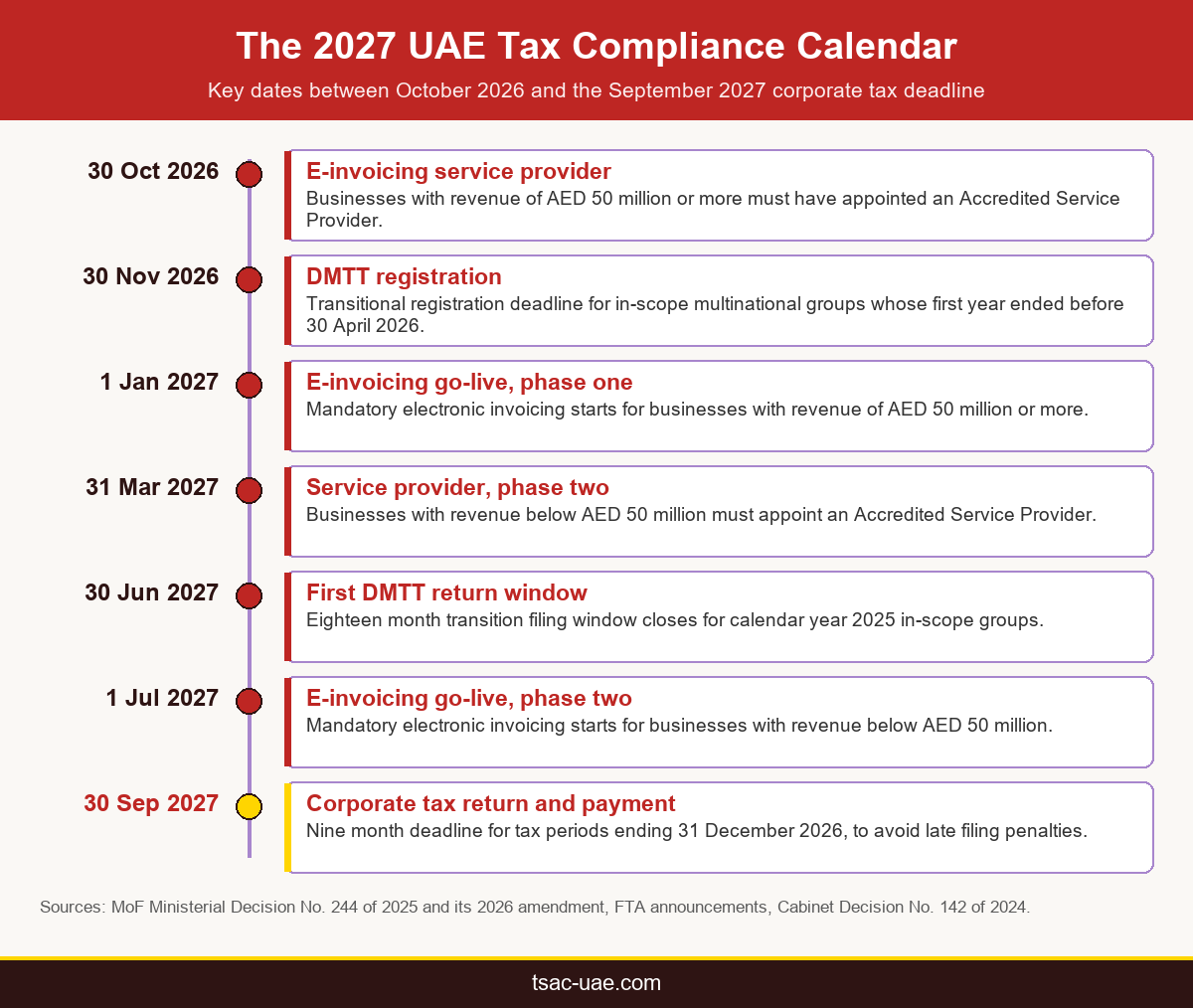
The same nine month rule sets the next big date for calendar year businesses: 30 September 2027. If you want a second opinion on your own timeline, you can talk to the TSAC advisory team before the year closes.
Yet the filing date is only one of several 2027 shifts. E-invoicing, stricter record standards and the new minimum tax all land in the same window. The smart move is to have your corporate tax consultants UAE side treat these changes as one project, not four separate deadlines.
This guide explains what changes, who it affects and what to fix first.
Key Takeaways
- The corporate tax filing deadline UAE 2027 for calendar year businesses is 30 September 2027, and the FTA has warned that late filing and poor records attract administrative penalties.
- Mandatory e-invoicing starts on 1 January 2027 for businesses with revenue of AED 50 million or more, and on 1 July 2027 for smaller businesses, which puts invoice data in front of the FTA far sooner.
- Small Business Relief now runs to 2029, but it still requires registration and a filed return, so a small business tax compliance consultant Dubai owners trust remains essential.
The Next Filing Date Is Closer Than It Looks
In short: tax periods that end on 31 December 2026 must be filed and paid within nine months, which means 30 September 2027. Businesses that treat this as a distant date often discover late that their 2026 books, audit and supporting schedules are not ready.
The FTA’s September 2026 announcement repeated a simple message: taxable persons must file and pay within nine months of the end of their tax period, and they must keep the documents that support every figure. Many first year filers only learned this in the final weeks, when year end adjustments, related party balances and missing invoices all surfaced at once. Our step by step filing guide walks through what the return actually asks for.
There is some relief for smaller firms. Ministerial Decision No. 131 of 2026 extended Small Business Relief to tax periods ending on or before 31 December 2029, with the AED 3 million revenue limit unchanged. Our breakdown of the three year extension explains who gains the full window. The catch is that relief is claimed through a return. It does not remove the need to register, keep records or file on time.
Businesses with a different year end face the same arithmetic on different dates. A company with a 31 March 2027 year end, for example, has until 31 December 2027 to file and pay. Mapping your own nine month window, rather than copying a date from the news, is the first job. Good corporate tax consultants UAE companies hire will also build in time for audited financial statements where they are required, since those usually take longer than the return itself.
E-Invoicing Turns Tax Data Into a Live Feed
In short: from 2027, invoices will flow to the tax system through accredited providers in close to real time. That makes corporate tax figures easier to test against transaction data, so gaps that once stayed hidden until an audit will show up much earlier.
Under Ministerial Decision No. 244 of 2025, businesses with revenue of AED 50 million or more must go live on 1 January 2027. Businesses below that level must appoint an Accredited Service Provider by 31 March 2027 and go live by 1 July 2027. The Ministry of Finance later moved the provider appointment date for larger businesses to 30 October 2026, but as Deloitte’s tax team notes, the go-live date did not move.
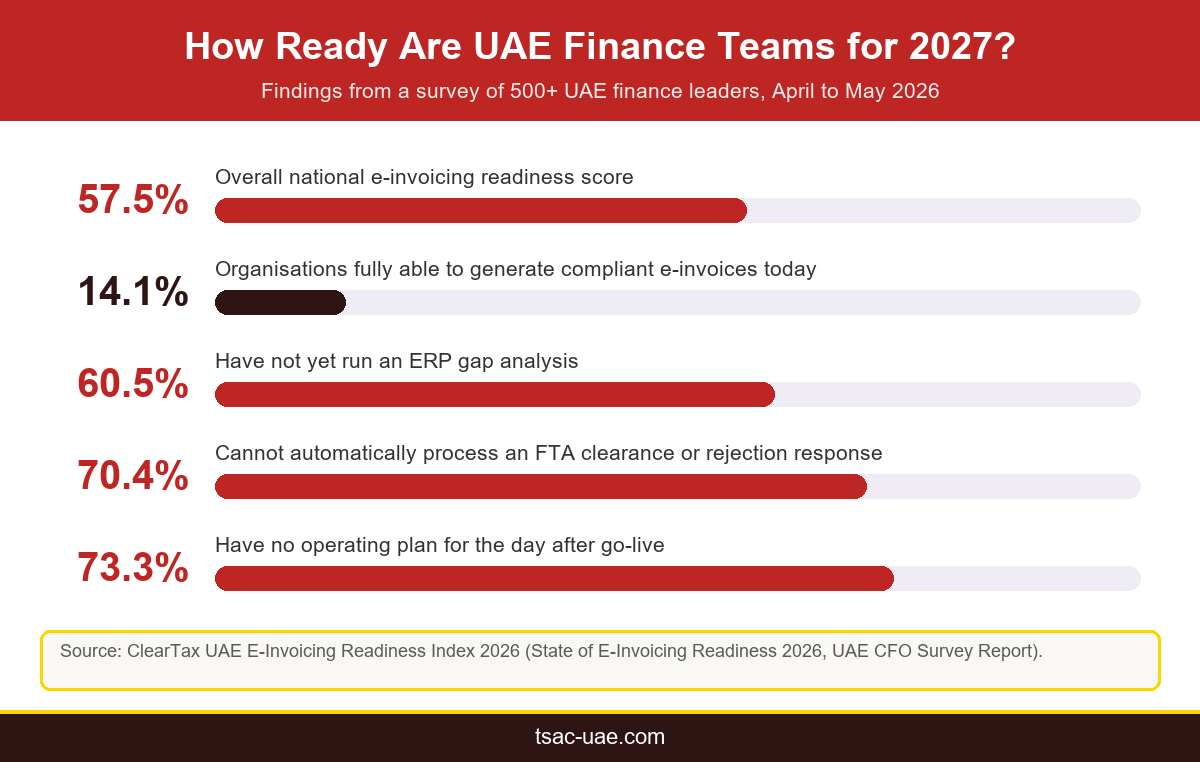
Readiness is the real concern. The ClearTax UAE E-Invoicing Readiness Index 2026, based on a survey of more than 500 finance leaders in April and May 2026, put national readiness at 57.5 percent. Only 14.1 percent of organisations could fully generate compliant e-invoices, and 73.3 percent had no plan for the day after go-live.
Why does this matter for corporate tax? Because revenue reported in your return will increasingly be compared with invoice data the authority already holds. Clean master data, correct tax treatment codes and a reconciled sales ledger now protect both your VAT and your corporate tax position. Our e-invoicing setup support is built around that connection.
A practical first step is a short gap review. Pull a sample of last quarter’s invoices, check that customer TRNs, tax codes and descriptions are complete, and note every field your system cannot produce today. That list becomes your brief when you speak to a provider, and it keeps onboarding conversations focused.
Records, Transfer Pricing and Minimum Tax Face Sharper Questions
In short: three quieter changes will shape how returns are reviewed in 2027. Record standards are stricter, related party pricing needs evidence, and large groups now carry a separate minimum tax. Each one adds documentation work that most finance teams underestimate.
FTA Decision No. 4 of 2026 took effect on 30 July 2026 and sets out how records must be kept, including that digital copies must be complete, legible and accessible to the authority. Our summary of the new record-keeping standards covers what that means in practice. Outsourcing your books does not move the legal responsibility away from you.
Related party transactions are another pressure point. Owner loans, management fees and group recharges all need to be priced and documented on an arm’s length basis. Our guide to downward pricing adjustments shows how easily a simple intercompany balance becomes a tax question.
For large multinational groups, the Domestic Minimum Top-up Tax applies a 15 percent floor from financial years starting on or after 1 January 2025. In-scope groups face a transitional registration date of 30 November 2026, and the first return window for calendar year 2025 groups runs to mid 2027. Our note on DMTT registration rules sets out the timelines.
The global context explains why this is happening. The Tax Foundation’s 2025 review puts the worldwide average statutory corporate rate at 23.58 percent across 181 jurisdictions, and lists the UAE among the countries below 15 percent that adopted a qualified domestic minimum tax. The UAE headline rate stays at 9 percent, but the compliance expectations around it are now firmly international.
What Small Businesses Should Fix Before 2027
In short: small businesses do not need a large tax department to get ready. They need a clear calendar, reconciled books and one adviser who owns the deadlines. Many filing problems trace back to unclear ownership rather than complex tax law.
Start with the basics. Confirm your tax period, your registration details and whether you plan to claim Small Business Relief. Then check that every related party balance, owner withdrawal and exempt income item is recorded with support. Reliable bookkeeping and accounting support is what makes a September return straightforward instead of stressful.
Next, plan for e-invoicing even if your go-live is July 2027. Ask your software vendor whether your system can issue compliant invoices, and budget for a provider before March 2027. Finally, agree who files, who reviews and who holds the documents. A small business tax compliance consultant Dubai companies can reach easily should own that checklist with you, with quarterly reviews rather than a single rush each September.
Choosing among corporate tax consultants UAE owners can rely on is easier when you look for three things: a named point of contact, a written compliance calendar and advice that joins corporate tax, VAT and e-invoicing together. TSAC offers registration, filing and advisory support across all three.
Conclusion
The biggest 2027 change is not a new tax rate. It is the way deadlines, invoice data and documentation rules now overlap. The corporate tax return for 2026 is due by 30 September 2027, e-invoicing goes live in two phases during the year, and record and minimum tax rules add fresh evidence requirements. Businesses that plan now will file calmly. Those that wait will pay in penalties and rushed fixes. If you want experienced corporate tax consultants UAE businesses already work with to review your position, book a free consultation with TSAC today.