Registered tax agents in uae hold a specific legal credential that many business owners confuse with a general accountant or auditor. Knowing the difference matters most exactly when it counts, during an FTA audit query or a disputed assessment, which is when only a registered tax agent can formally represent a company, and this guide sets out exactly what that distinction means in practice.
Key Takeaways
- A registered tax agent is listed on the FTA’s own public register and is the only role legally permitted to represent a business before the authority.
- Accountants prepare books and records but cannot represent a company at the FTA unless separately registered as a tax agent.
- Approved auditors sign statutory audit opinions but do not act as a company’s FTA representative either, since audit and tax agency are distinct FTA authorisations.
What a Registered Tax Agent Is Legally Permitted to Do
A registered tax agent is an individual or firm approved by the Federal Tax Authority to represent a taxable person in matters relating to their tax obligations. This includes preparing and submitting returns, communicating with the FTA on a company’s behalf, and representing the business during an audit or dispute. Anyone claiming to offer FTA representation without appearing on the FTA’s public tax agent register is not legally authorised to act in that capacity.
The registration process for becoming a tax agent itself involves meeting FTA qualification and experience requirements and passing the authority’s own assessment, which is why the credential carries real weight. It is not simply a job title a firm chooses to use in its marketing.
The scope of representation also extends to voluntary disclosures and penalty reconsideration requests, both of which involve direct correspondence with the FTA on a company’s behalf. A business handling either of these situations without a registered tax agent is effectively navigating the process alone, even if it has other financial advisors involved.
The FTA also expects a registered tax agent to maintain proper working papers and professional standards for every client they represent, which is part of why the credential is renewed periodically rather than granted permanently. A business working with an agent whose registration has lapsed is, in effect, back to representing itself at the FTA without realising it.
How This Differs From an Accountant’s Role
An accountant or bookkeeper prepares financial records, reconciles transactions and produces management accounts, but this role alone does not authorise them to represent a company at the FTA. Many UAE businesses use an in-house or outsourced accounting function for day to day bookkeeping while separately appointing a registered tax agent for FTA facing matters, since the two functions require different credentials and, often, different skill sets.
This division of labour is not a weakness in a business’s compliance setup. A strong accounting function that keeps daily records accurate, paired with a registered tax agent who steps in for FTA correspondence and filings, is a common and effective structure, provided both sides are actually communicating with each other rather than operating in isolation.
Problems tend to arise when a business assumes its accountant is handling FTA correspondence simply because that accountant prepares the underlying figures. A short, direct conversation clarifying exactly who is responsible for filing, who is responsible for FTA communication, and who is responsible for representation in a dispute removes this ambiguity before it matters.
For a growing SME, the point at which it starts to make sense to formally separate these functions is usually when the business begins dealing with the FTA directly for the first time, whether through a routine query or a more involved audit. Businesses that wait until that point to think about who is authorised to respond often lose valuable time in the early stages of the interaction.
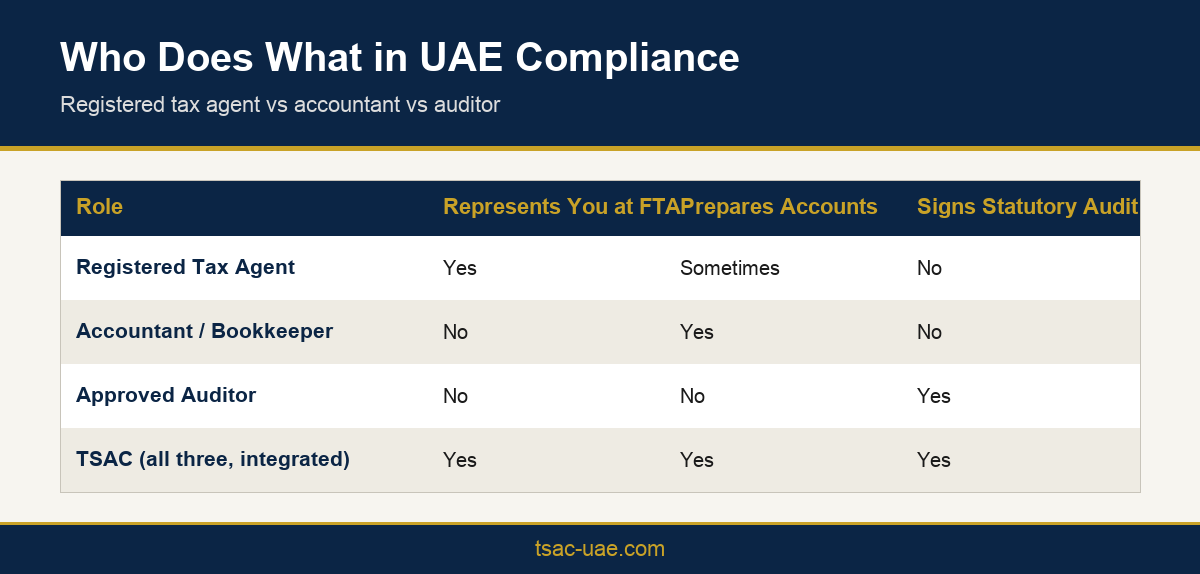
What a registered tax agent, an accountant and an auditor are each legally permitted to do.
How This Differs From an Auditor’s Role
An approved auditor signs a statutory audit opinion on a company’s financial statements, a requirement for most free zone license renewals and for companies above certain size thresholds. Being an approved auditor does not automatically make someone a registered tax agent, since the FTA maintains these as two separate authorisations with different qualifying criteria.
A business should not assume that because its auditor is well qualified and licensed to sign audit opinions, that same auditor is also authorised to represent the company in an FTA dispute. Confirming both credentials separately, rather than assuming one implies the other, avoids an awkward gap during an active FTA query.
It is also worth noting that an approved auditor’s independence requirements can, in some circumstances, limit how closely that same firm can be involved in preparing the underlying accounts it later audits. This is a separate professional consideration from tax agency, but it reinforces why audit, accounting and tax representation are treated as distinct functions rather than interchangeable services.
Why This Distinction Matters at Renewal and Audit Time
The distinction becomes practical during an FTA query, a tax residency certificate application, or a free zone license renewal that needs both an audit opinion and FTA correspondence handled correctly. A firm that holds registered tax agent status and also offers audit services, as TSAC does, can manage both sides of a renewal without a business needing to coordinate two separate advisors.
This matters most under time pressure. A business facing an FTA query close to a renewal deadline does not want to discover, in the middle of that process, that its existing advisor cannot actually respond to the FTA on its behalf and a separate registered tax agent needs to be brought in at short notice.
Bringing in a new registered tax agent mid dispute also means that agent has to get up to speed on a company’s history and documentation under time pressure, which is far less effective than working with an agent who has followed the business’s filings from the start.
How to Verify a Registered Tax Agent Before You Appoint One
The FTA’s public tax agent register lists every currently approved agent and, in most cases, the firm they are associated with. Before appointing an advisor for FTA facing work, a business should search this register directly rather than relying on a claim made in a proposal or on a website. Confirming the registration is current, not expired or under review, takes a few minutes and removes any doubt about whether the advisor can actually act in the capacity being offered.
It is also reasonable to ask a prospective advisor which specific individual within their firm holds the registered tax agent credential, since the credential belongs to a person, not automatically to every employee of a firm that has one registered agent on staff. Businesses that skip this check sometimes discover, only when an issue arises, that the person actually handling their account is not the one holding the registration.
This verification step takes on added importance whenever a business changes advisors, whether moving from an individual freelance consultant to a firm or switching between firms entirely. Each transition is a natural point to confirm registered tax agent status again rather than simply carrying forward an assumption from the previous relationship.
Conclusion
Registered tax agents in uae are the only professionals legally authorised to represent a business before the FTA, a distinct role from the accountant who keeps the books or the auditor who signs the annual opinion. Checking an advisor’s status on the FTA’s public register before appointing them for FTA facing work is a simple step that avoids relying on someone without the authority to act. It is a step worth taking before a dispute arises, not during one, since verifying credentials under time pressure is far harder than confirming them at the outset of an advisory relationship. TSAC is a registered tax agent offering accounting, audit and tax representation under one roof.
Frequently Asked Questions
How do I check if someone is a registered tax agent in the UAE?
The FTA publishes a public register of approved tax agents, and businesses should confirm an advisor appears on this list before relying on them for FTA representation.
Can my accountant represent my company during an FTA audit?
Only if that accountant is separately registered as an FTA tax agent. A general accountant without this credential cannot formally represent a business in an FTA audit or dispute.
Is a registered tax agent the same as a tax consultant?
Not necessarily. Tax consultant is a general descriptive term, while registered tax agent is a specific FTA authorised status that only some consultants actually hold.
Do I need a registered tax agent to file corporate tax returns?
A company can file its own returns, but many businesses appoint a registered tax agent to reduce error risk and to have professional representation available if the FTA raises questions.
Can an auditor also be a registered tax agent?
Yes, some professionals hold both credentials, but the two are separate FTA authorisations and one does not automatically grant the other.
What should I ask before hiring a UAE tax agent?
Confirm their registration status on the FTA register, ask whether they also offer corporate tax filing support, and check their experience with your specific free zone or emirate.