
Losing the QFZP status free zone companies work hard to earn is more common than most business owners expect, and the consequences arrive faster than the paperwork suggests. One missed condition, one compliance gap, and qualifying income that was taxed at 0 percent can become taxable at the standard 9 percent rate, sometimes retroactively. This guide explains what actually triggers disqualification, what changes financially and operationally the day it happens, and how ongoing monitoring prevents it before a routine review turns into a costly correction.
Key Takeaways
- QFZP status is not a one-time award. It must be maintained continuously, and failing any condition during a tax period can trigger disqualification, with the corporate tax rules applying retroactively.
- Once qfzp status revoked, the standard 9 percent rate typically applies for the tax period of failure plus a multi-year ineligibility window, not just the year the issue occurred.
- Most disqualifications trace back to preventable gaps, missed de minimis thresholds, thin economic substance, or late filings, that a dedicated compliance point of contact would normally catch.
What QFZP Status Actually Protects
Qualifying Free Zone Person status is what allows eligible free zone entities to pay 0 percent corporate tax on qualifying income, while non-qualifying income is taxed at the standard free zone 9% tax rate. The Federal Tax Authority grants this status based on a set of conditions that must be met continuously, not just at the point of first registering with the FTA. Our overview of the conditions behind the 0 percent rate explains the qualifying conditions in more depth.
The rate is not a fixed label attached to your free zone licence. It is a status you hold only while your income mix, substance, and reporting continue to meet the qualifying conditions. That distinction matters because many business owners assume that once granted, the 0 percent rate is permanent. It is closer to a renewable licence than a certificate, and treating it that way is what keeps qfzp status revoked risk low. For context on how registration and ongoing status differ, see our guide on how registration differs from ongoing status.
The Compliance Triggers That Lead to Disqualification
The disqualification rules describe a handful of recurring triggers, most of which are preventable with routine monitoring. The infographic below summarises the most common ones the FTA reviews.
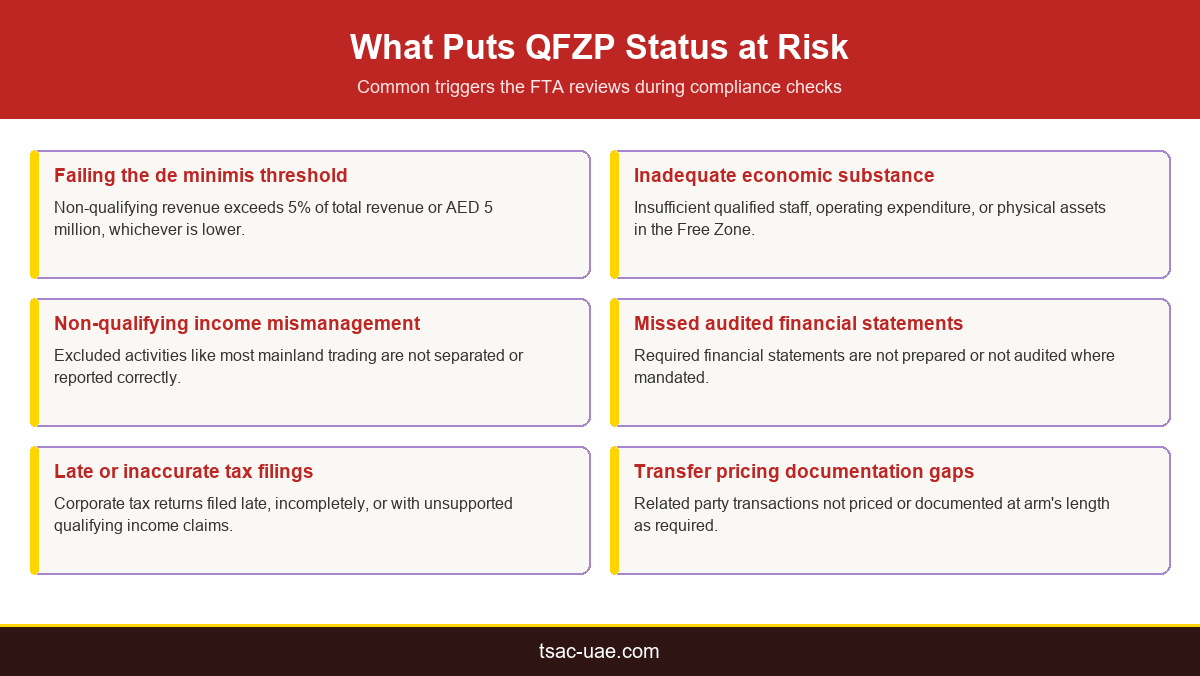
The de minimis threshold, non-qualifying revenue capped at the lower of 5 percent of total revenue or AED 5 million, is the trigger businesses breach most often, usually without realising it until a review flags it. Inadequate economic substance, insufficient qualified staff, operating expenditure, or physical presence in the free zone, is a close second. Our guide on compliance and governance obligations covers why substance requirements are assessed alongside income classification, not separately from it.
Late or inaccurate filings compound the risk. A free zone entity that files its corporate tax return late, or claims qualifying income it cannot support with documentation, invites the kind of scrutiny that surfaces other gaps. Missing audited financial statements where mandated, and unsupported transfer pricing positions on related party transactions, round out the list of triggers we see most often in practice.
What Changes the Day You Lose QFZP Status
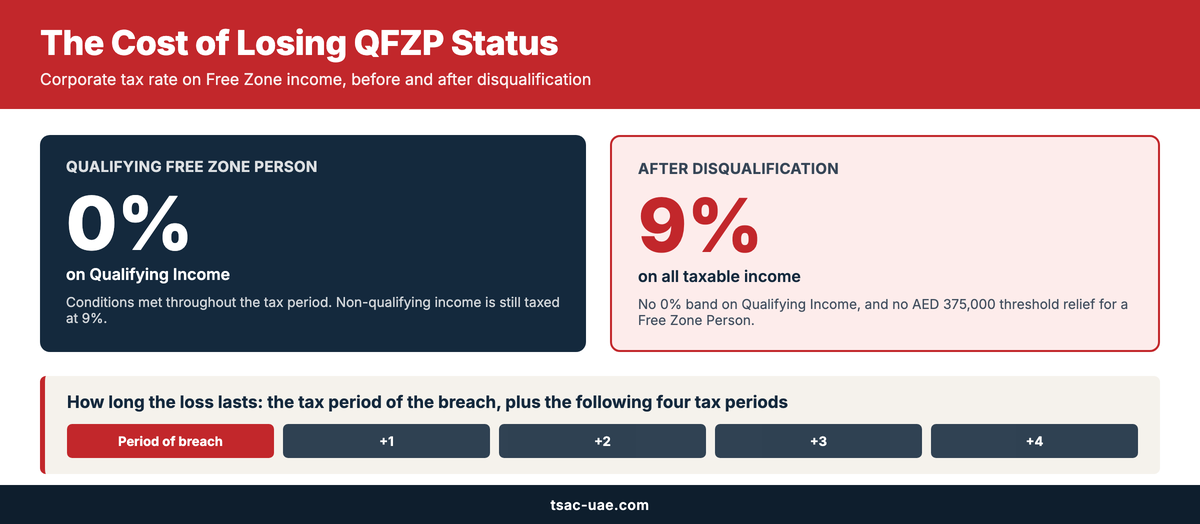
The financial shift is immediate and significant, moving qualifying income from 0 percent to the standard 9 percent rate. Under the framework described in the FTA’s guide on Free Zone Persons, a Free Zone Person that fails to meet the conditions generally ceases to qualify from the start of the relevant tax period and remains ineligible for a multi-year period afterward, not just for the year the failure occurred. The infographic below shows how the rate and relief window compare before and after.
Beyond the rate change, a free zone corporate tax penalty can apply on top of the additional tax owed if the disqualification stems from a filing or disclosure failure rather than a genuine change in business activity. Our article on how expert corporate tax services help you avoid penalties outlines how these penalties stack, and why businesses that catch an issue internally before an FTA review tend to face materially lower costs than those that do not.
There is also a reputational dimension. Investors, banks, and free zone authorities increasingly ask about corporate tax standing during due diligence. Our piece on how corporate tax compliance influences a company’s reputation covers why a disqualification event, even after it is resolved, can surface in later commercial conversations if it is not documented and explained clearly.
Can You Recover QFZP Status After Losing It?
Recovery is possible but not immediate. Businesses generally need to demonstrate that the underlying issue, whether a substance gap, an income classification error, or a filing lapse, has been corrected and that the entity can sustain compliance going forward before the FTA will reconsider eligibility for a future tax period. This is a longer process than most business owners expect, which is why prevention is far less costly than correction.
In the meantime, the entity remains liable for corporate tax at the standard rate on qualifying income for the ineligibility window. Businesses in this position often benefit from a full corporate tax compliance review to confirm exactly what triggered the loss of status and to build a remediation plan the FTA will recognise as genuine, rather than a temporary fix designed only to pass the next review.
This is precisely where specialist advisory support becomes more than a filing question. A consultant who understands both the technical conditions and your specific free zone operations can distinguish between a genuine, defensible position and a claim that will not hold up under FTA review. Our explainer on what that advisory role involves sets out what that support should look like in practice, from the first registration through every renewal of your Qualifying Free Zone Person status.
How a Dedicated Point of Contact Prevents Disqualification Before It Happens
Most QFZP disqualifications are not the result of a single dramatic event. They build slowly, a de minimis threshold that creeps upward over several quarters, a staffing change that quietly reduces substance, a filing that goes out a few days late because no one owned the deadline. Generic, one-time filing services are not built to catch that kind of gradual drift.
TSAC assigns every free zone client a dedicated point of contact who tracks qualifying and non-qualifying income, substance indicators, and filing deadlines on a live dashboard, rather than revisiting compliance only at year end. That is the same model we apply across VAT, Economic Substance Regulations, and transaction advisory work, so that a risk showing up in one area is flagged before it affects your corporate tax standing in another. Businesses that want this kind of ongoing oversight, rather than a once-a-year filing relationship, can read what current clients say on our testimonials page.
The FTA’s own public clarifications database is worth monitoring directly if your finance team wants to track how the authority is interpreting free zone conditions in practice, alongside the guidance summarised in this article.
Conclusion
Losing the QFZP status free zone businesses fight hard to earn is rarely sudden. It is usually the outcome of a threshold, a substance gap, or a filing lapse that went unmonitored until an FTA review surfaced it. Understanding the triggers, and the real financial impact of the standard 9 percent rate applying retroactively, is the first step toward protecting your status. The second step is ongoing monitoring rather than annual review. Book a free consultation with TSAC to get a dedicated point of contact watching your qualifying income, substance, and filings year round.
Frequently Asked Questions
What is the tax rate after a free zone company loses QFZP status?
Qualifying income that was taxed at 0 percent generally becomes subject to the standard 9 percent rate for the tax period of the failure and a following multi-year period, based on FTA free zone guidance.
Can a single mistake cause qfzp status revoked outcomes?
A single serious breach, such as materially exceeding the de minimis threshold, can trigger disqualification, though most cases involve a pattern of smaller issues that compound over time.
Does losing QFZP status affect VAT registration?
No. Corporate tax status and VAT registration are assessed separately, though a business under corporate tax review often faces closer scrutiny on VAT filings too.
How does the FTA identify free zone company disqualification triggers?
Through corporate tax return data, audited financial statements, and periodic compliance reviews that compare declared qualifying income against the entity’s actual substance and activities on record.
Is there a grace period before a free zone corporate tax penalty applies?
Some administrative penalties allow correction within a defined window. Our basics of corporate tax guide explains which penalty types allow correction and which apply immediately.
Can a free zone company reapply for QFZP status after disqualification?
Yes, generally after demonstrating sustained compliance and correcting the underlying issue, though reapplication timing depends on the specific conditions that were not met.
Does disqualification apply to the whole group or just one entity?
QFZP status is assessed per licensed legal entity. A disqualification affecting one free zone company does not automatically extend to related entities, though shared risk factors often affect several at once.
What records prove a free zone company still qualifies for QFZP status?
Audited financial statements, substance documentation such as staff and lease records, and accurate income classification between qualifying and non-qualifying activities are the core evidence the FTA reviews.
Why do family owned free zone businesses face particular disqualification risk?
Ownership and governance structures can blur income classification. Our piece on family foundations and UAE corporate tax covers related considerations for closely held structures.
How often should a free zone company review its QFZP compliance?
Quarterly reviews catch drift in income mix and substance long before an annual filing does, which is why ongoing monitoring outperforms a once a year compliance check for free zone entities.