
A Qualifying Free Zone Person does not earn the 0 percent corporate tax rate simply by operating in a free zone. It has to prove eligibility every year with documentation that stands up to scrutiny. A free zone corporate tax audit uae requirement sits at the centre of that proof, and the record keeping habits a business builds today determine how smoothly that audit goes. This guide covers what auditors and the Federal Tax Authority expect, which records to retain, and how ongoing tracking replaces a stressful scramble before the deadline.
Key Takeaways
- Every Qualifying Free Zone Person must prepare free zone company audited financial statements regardless of revenue size, unlike some mainland small businesses that qualify for exemptions.
- Free zone corporate tax record keeping rules require supporting documents to be retained for at least 7 years from the end of the relevant tax period.
- Meeting the qfzp audit requirement is far easier with continuous, dashboard based document tracking than with a single annual collection exercise.
Why Free Zone Corporate Tax Audits Are Non-Negotiable
Under the Federal Tax Authority’s rules for free zone entities, a Qualifying Free Zone Person must prepare audited financial statements to support the Qualifying Income figure reported on its corporate tax return. This applies even to entities that would otherwise be small enough to claim relief under general corporate tax rules, because the 0 percent rate is a privileged status that carries a correspondingly higher evidentiary bar. For background on how the overall filing process works, see our complete guide to annual returns.
The audit is not a formality. It is the mechanism the Federal Tax Authority relies on to confirm that revenue has been classified correctly between qualifying and non-qualifying categories, that related party transactions are priced at arm’s length, and that the entity genuinely maintains substance in the free zone. Our audit services team works directly with our tax advisory group so that the same figures feeding your corporate tax return are the ones your auditor signs off on, rather than two separate processes that have to be reconciled after the fact.
What Records a Free Zone Company Must Keep
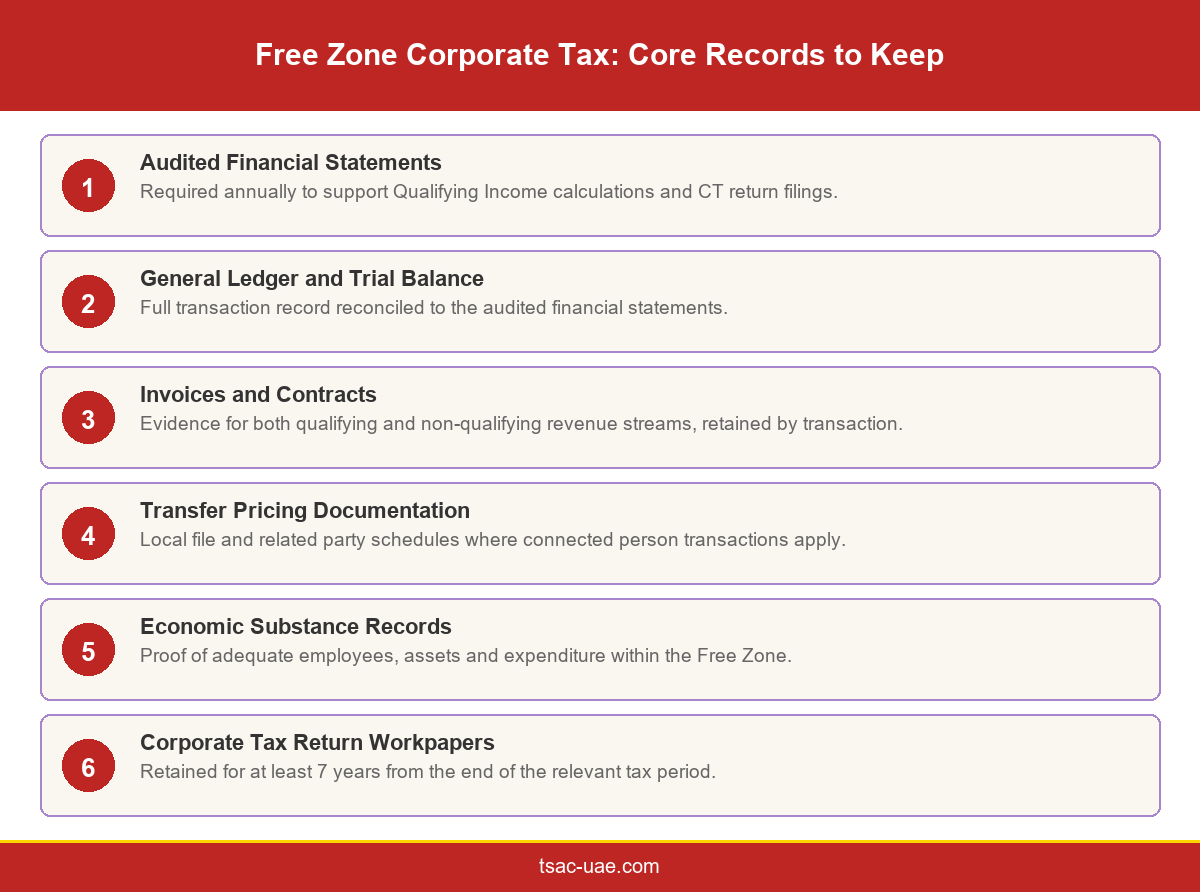
Free zone corporate tax record keeping goes well beyond the audited financial statements themselves. Businesses need a general ledger and trial balance that reconcile cleanly to those statements, invoices and contracts that evidence both qualifying and non-qualifying revenue streams, and transfer pricing documentation wherever transactions with related or connected persons are involved. Our note on downward transfer pricing adjustments explains why this documentation matters even for routine intercompany arrangements.
Economic substance evidence, covering adequate employees, physical assets, and operating expenditure within the free zone, also needs to be retained alongside the tax file. Our economic substance regulations service is built to keep this evidence current year round rather than compiled retroactively when an audit is scheduled. Businesses issuing invoices through our electronic invoicing workflow already generate much of this trail automatically, which materially shortens audit preparation time.
How Long Records Must Be Retained
Corporate tax records, including everything that supports a filed return, must generally be retained for at least 7 years from the end of the relevant tax period. For a Free Zone company, this means the workpapers behind a single de minimis calculation, a transfer pricing position, or an economic substance declaration can all be requested by the Federal Tax Authority years after the return was originally filed.
The Federal Tax Authority periodically issues public clarifications that refine how specific record keeping scenarios should be handled, and the Ministry of Finance publishes the underlying policy updates. Businesses relying on a single annual filing exercise often miss these updates entirely, which is one reason our corporate tax compliance services include a standing review of new guidance as it is released, not just a once a year filing service.
Common Audit and Documentation Gaps We See in Free Zone Businesses
The most frequent gap is a mismatch between the general ledger and the revenue classification used on the corporate tax return, usually because bookkeeping was done without corporate tax categories in mind. The second most common gap is missing evidence for related party pricing, since many free zone groups transact with affiliated companies without documenting the basis for pricing at the time. Our article on who qualifies as a director or officer under UAE corporate tax law is also relevant here, since key management personnel decisions often intersect with related party documentation requirements.
A third gap shows up in companies that update their registration details late. Our guide on keeping those details current and our explainer on the penalties for skipping this step both describe how registration accuracy feeds directly into audit readiness, since auditors check registration details against the entity’s actual trading activity.
How a Dedicated Point of Contact Keeps You Audit Ready Year Round
A Big 4 style annual audit engagement typically begins with a lengthy document request list handed to a client that has weeks, not months, to assemble everything. For an SME or mid market free zone business without a dedicated finance team, that scramble is where most compliance documents get missed.
Our model assigns a dedicated point of contact to each free zone client, supported by a dashboard that tracks which compliance documents are current, which are due for renewal, and which are missing, in real time rather than at audit time. This pairs directly with our accounting services and transaction advisory work, so structural changes to your business are reflected in your documentation the moment they happen rather than reconstructed months later. Our piece on how corporate tax compliance influences a company’s reputation explains why this level of readiness increasingly matters to banks and investors as well as to the Federal Tax Authority.
What This Means for Your Business: An Audit Readiness Checklist
Free zone businesses that treat audit preparation as a continuous process, not a year end sprint, consistently spend less time and money on the audit itself. Use this checklist as a starting point:
- Reconcile the general ledger to your qualifying and non-qualifying revenue classification every quarter, not once a year.
- Store contracts and invoices in a structure that lets an auditor trace any transaction back to its revenue category within minutes.
- Document related party pricing at the time a transaction is agreed, not retroactively when the audit begins.
- Retain every corporate tax record for a minimum of 7 years, including workpapers that never made it into the final filed return.
- Review economic substance evidence alongside your audit file, since the two are assessed together by the Federal Tax Authority.
For businesses still building this discipline internally, our Dubai advisory guide and our explainer on what that advisory role involves both describe how outsourced support closes these gaps without requiring an in house finance hire.
Conclusion
The free zone corporate tax audit uae requirement is not a hurdle to clear once a year. It is a standing obligation that rewards businesses with disciplined, continuous record keeping and penalises those that treat compliance as an annual event. Our approach pairs a dedicated point of contact with dashboard visibility so that free zone companies of any size stay audit ready throughout the year, not just in the weeks before filing. Our guide on corporate tax compliance and governance expands on how this fits into a wider governance framework. To review your current audit and record keeping position, book a free consultation with our team.
Read more about our approach on our about page, browse common questions on our FAQs page, or see what free zone clients say on our testimonials page.
Frequently Asked Questions
Do all free zone companies need audited financial statements?
Yes. A Qualifying Free Zone Person must prepare audited financial statements to support its corporate tax position, regardless of whether it would otherwise qualify for a small business exemption on the mainland.
What is the free zone corporate tax audit uae requirement based on?
It is based on Federal Tax Authority rules requiring audited statements to evidence Qualifying Income, substance, and correct revenue classification for the 0 percent rate to apply.
How long must free zone corporate tax records be kept?
Records must generally be retained for at least 7 years from the end of the relevant tax period, covering workpapers as well as the final filed return.
What documents count as free zone company compliance documents?
Audited financial statements, general ledgers, invoices, contracts, transfer pricing files, and economic substance evidence together make up the core compliance document set.
What triggers a free zone corporate tax audit?
Filing a corporate tax return claiming Qualifying Free Zone Person status triggers the annual audit requirement. The Federal Tax Authority can also request records at any point within the retention period.
Can a small free zone company skip the audit requirement?
No. Unlike some mainland small businesses, Qualifying Free Zone Persons must prepare audited financial statements regardless of revenue size to retain the 0 percent rate.
What happens if audit documentation is incomplete?
Incomplete documentation puts Qualifying Free Zone Person status at risk and can result in the standard 9 percent rate applying, alongside potential penalties for inadequate record keeping.
How does transfer pricing documentation relate to the audit?
Auditors and the Federal Tax Authority both review related party transactions for arm’s length pricing, so transfer pricing documentation is a standard part of the free zone audit file.
Who is responsible for free zone corporate tax record keeping?
The Free Zone Person itself remains legally responsible, though most SMEs assign the ongoing task to an outsourced accounting and tax advisory team to keep records current between audits.
How can a dedicated point of contact help with audit readiness?
A dedicated point of contact tracks document status continuously through a dashboard rather than compiling everything at once, which is why our basics of corporate tax guide recommends building this habit early rather than after the first audit notice.