If you run a UAE free zone business, one question decides your tax bill more than any other: do you meet the criteria
to be treated as a Qualifying Free Zone Person. This status is what separates a 0 percent corporate tax rate on
qualifying income from the standard 9 percent rate that applies to every other taxable person in the UAE. This guide
breaks down the exact criteria the Federal Tax Authority checks, in plain language, so you can assess your own
business today rather than waiting for a filing deadline to find out.
Key Takeaways
- QFZP status depends on five specific criteria that must all be met together, not just one or two of them.
- Meeting the criteria is an ongoing requirement, reviewed each tax period, not a one time application.
-
SME and mid market free zone businesses benefit most from tracking these criteria continuously with a dedicated
advisor rather than reviewing them once a year.
What QFZP Status Actually Requires
A Qualifying Free Zone Person is not defined by your trade licence alone. According to the
FTA’s official guidance for free zone entities, your entity must be a free zone person that meets every one of the conditions set out in the corporate tax law, at
the same time, throughout the tax period. Meeting four out of five criteria does not give you a partial benefit. It
generally means the 0 percent rate does not apply for that period. This all or nothing structure is why free zone
businesses need more than a general awareness of the rules covered in our
UAE corporate tax key highlights article. You
need a criteria by criteria check specific to your business.
This is also the point where many owners first ask
whether they need specialist advice
rather than relying on general reading. The criteria below are written into the corporate tax law itself, and the FTA
has also issued public clarifications that
refine how specific scenarios are treated. Understanding
what that advisory role involves in
this process is largely about translating that regulatory detail into decisions your finance team can actually act on
this quarter.
Criterion 1: Your Entity Must Be Registered in a UAE Free Zone
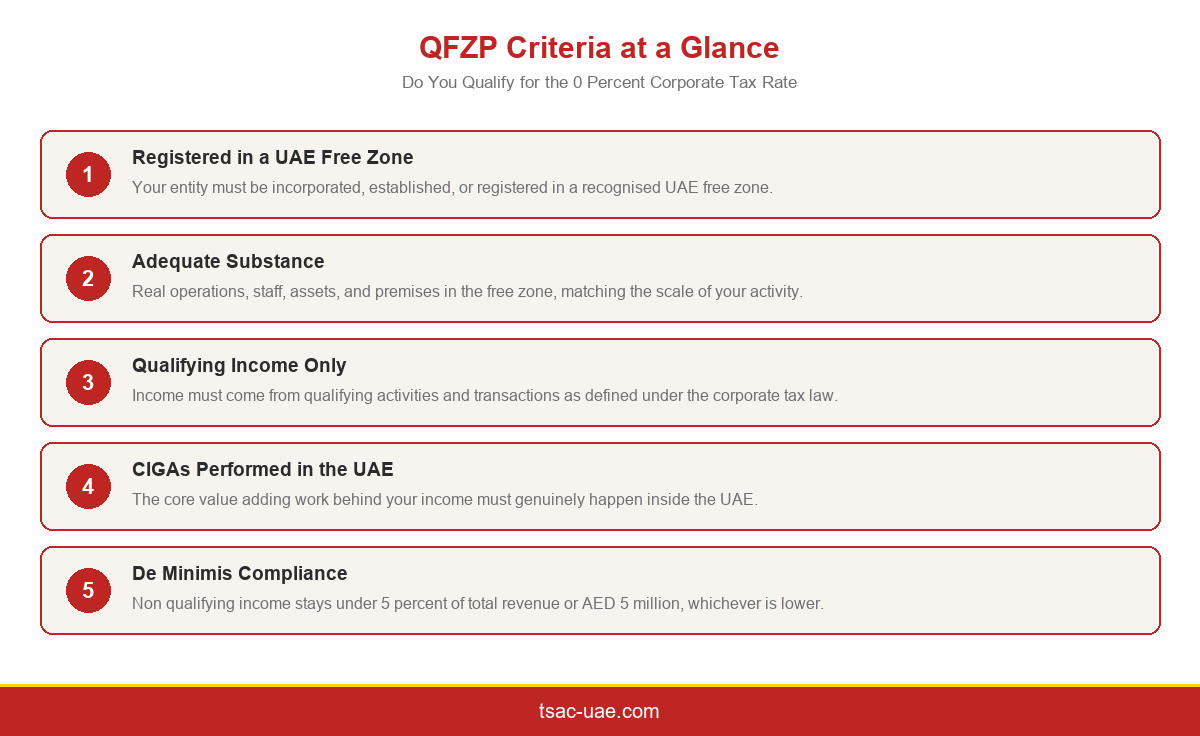
This sounds obvious but it is the foundation everything else depends on. Your entity must be incorporated,
established, or otherwise registered in a free zone recognised under the corporate tax law, and it must hold a valid
free zone licence for the activity generating its income. What this means for your business: if you operate across a
free zone and mainland presence under related entities, only the free zone entity itself can be assessed for QFZP
status, and only for income properly attributed to that entity. Confirming this structure early, ideally at the
business incorporation stage, avoids
classification disputes later.
The
FTA’s general corporate tax overview
confirms that free zone persons remain within the corporate tax regime by default. QFZP status is a conditional relief
layered on top of that default position, not a separate tax system, and every free zone entity needs a
Tax Identification Number as part of standard
registration regardless of its eventual QFZP outcome.
Criterion 2: You Must Maintain Adequate Substance
Adequate substance means your free zone entity genuinely operates where it says it does. You need enough qualified
employees, adequate assets, and adequate operating expenditure in the free zone to support the income you are earning,
and your Core Income Generating Activities must actually take place there. A registered address with no staff and no
operational activity will not meet this test, regardless of how the entity is structured on paper. This criterion
overlaps closely with the substance work covered under our
economic substance regulations service, and
businesses that already maintain strong ESR files typically find the QFZP substance test easier to evidence.
-
What this means for your business: keep a current staff list mapped to the specific activities they perform in the
free zone. -
What this means for your business: retain lease agreements, utility records, and asset registers that match your
stated activity. - What this means for your business: review operating expenditure against income at least quarterly, not once a year.
Criterion 3: Your Income Must Be Qualifying Income
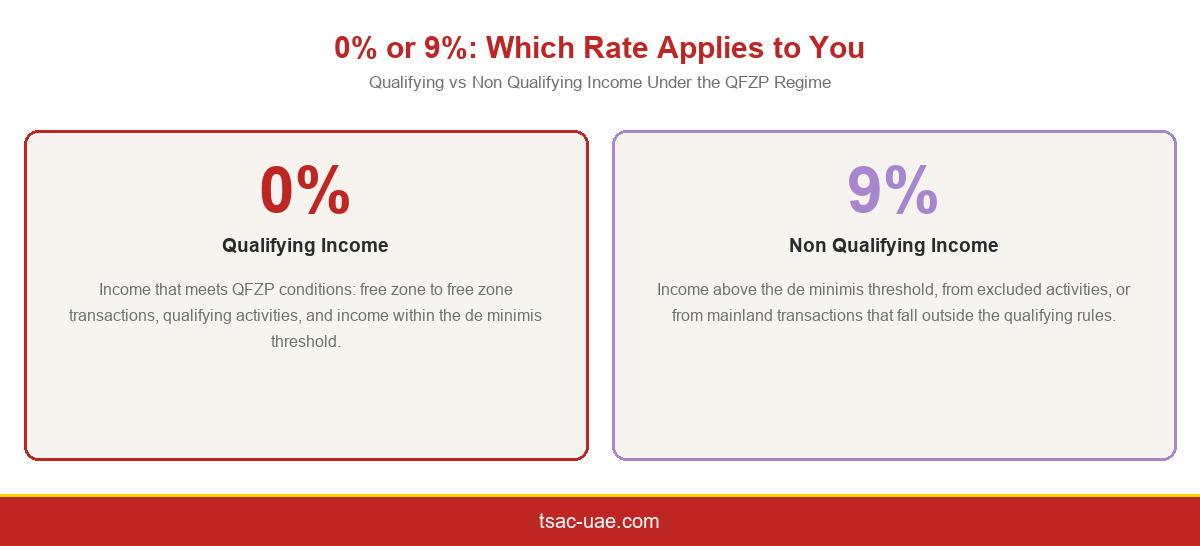
Not all revenue earned by a free zone entity counts toward the 0 percent rate. Qualifying income generally includes
transactions with other free zone persons who are the beneficial recipient of the goods or services, income from a
defined list of qualifying activities, and income from qualifying intellectual property under specific conditions.
Income from excluded activities, most transactions with natural persons, and most banking or insurance activity
outside narrow exceptions does not qualify, no matter how the contract is worded. Reviewing your
past filings against this
list is a useful first step if you have already filed at least one return under the standard rate.
Criterion 4: You Must Stay Within the De Minimis Threshold
A small amount of non qualifying revenue is tolerated, but the limit is strict. Non qualifying revenue must stay under
the lower of 5 percent of your total revenue or AED 5 million in the tax period. Cross either line and the consequence
is not proportional. Your entity loses QFZP status for the current tax period and the following four tax periods, a
full five years, with the 9 percent rate applying to all income during that time, not just the non qualifying portion.
This is the single most common reason free zone businesses lose the 0 percent rate, often without realising it until
the year end review. Our guide on why
effective corporate tax planning is crucial for your business
explains how to build a forecast that flags this risk before it happens.
Criterion 5: You Must Meet Transfer Pricing and Filing Obligations
The final criterion is procedural but just as strict as the others. Your entity must comply with the transfer pricing
rules and documentation requirements under the corporate tax law, and it must prepare audited financial statements
where required. A free zone entity with strong substance and correctly classified income can still fail this criterion
if related party transactions are not priced or documented at arm’s length, or if required financial statements are
missing. This is also where correctly identifying your
key management personnel
matters, since related party rules extend to transactions with directors and officers, not just group companies. Our
audit services team supports the financial statement
side of this requirement directly.
What to Do If You Do Not Meet the Criteria Yet
Not meeting every criterion today does not mean the opportunity is closed. Most gaps we see, whether it is a substance
shortfall, an unclassified revenue line, or missing transfer pricing documentation, are fixable within a tax period if
identified early. What this means for your business: treat this as a diagnostic exercise now, not a compliance task to
defer until filing season. If you have not yet completed
the registration step or
confirmed your
Tax Registration Number, that is the
starting point, since QFZP status is assessed as part of your corporate tax return, not through a separate
application. Businesses that skip registration entirely face the penalties described in our article on
the penalties for skipping this step, on top of losing the opportunity to claim the 0 percent rate.
If your business is still building foundational knowledge, our guide to the
basics of corporate tax every entrepreneur should know
is a good starting point before you tackle the QFZP criteria in detail. And if your free zone entity also has
VAT registration and filing obligations, or regularly
enters into related party or cross border arrangements that would benefit from
transaction advisory support, those workstreams
should be reviewed alongside your QFZP position, not separately, since they draw on the same underlying financial
records. Our article on how
expert corporate tax services help you avoid penalties
covers the practical side of keeping all of these obligations aligned under one advisor.
This is exactly the kind of gap analysis TSAC runs for SME and mid market free zone clients. Rather than a generic
technical summary, our team assigns a dedicated point of contact who reviews your specific licence, income streams,
and substance file against all five criteria, then tracks the gaps to closure with dashboard reporting so you can see
progress in real time instead of waiting for a year end surprise. Explore our full
corporate tax services or
book a free consultation to get a criteria by criteria
review of your free zone entity.
Conclusion: Check Every Criterion, Not Just the Obvious One
Qualifying for the 0 percent corporate tax rate as a QFZP comes down to five criteria that all have to hold true at
the same time: free zone registration, adequate substance, qualifying income, staying under the de minimis threshold,
and meeting your transfer pricing and filing obligations. Missing any one of them, even briefly, can cost your
business the 0 percent rate for up to five tax periods. If you want a clear, practical read on where your free zone
business stands against each of these criteria,
book a free consultation with our corporate tax team, or
read more about
how corporate tax services can benefit your business
before your next filing deadline.
Frequently Asked Questions
Q1. What are the QFZP criteria in the UAE?
The five QFZP criteria are free zone registration, adequate substance, qualifying income, staying within the de
minimis threshold, and meeting transfer pricing and audited financial statement obligations. All five must be met
together.
Q2. Do I need to meet all QFZP criteria, or just most of them?
All five criteria must be met at the same time during the tax period. Failing even one generally means the 0 percent
rate does not apply for that period.
Q3. What is the de minimis threshold for QFZP status?
The de minimis threshold is the lower of 5 percent of total revenue or AED 5 million in a tax period. Exceeding it
causes loss of QFZP status for five tax periods.
Q4. Can a new free zone company qualify for QFZP status in its first year?
Yes, provided it meets all five criteria from the start, including adequate substance and qualifying income
classification, even as a newly incorporated entity.
Q5. Does a free zone person automatically qualify for the 0% tax rate?
No. A free zone licence alone does not grant the 0 percent rate. The entity must separately satisfy all QFZP criteria
each tax period.
Q6. What happens if my free zone business fails one QFZP criterion?
The entity generally loses QFZP status for the current tax period and the following four tax periods, with the
standard 9 percent rate applying to all income during that time.
Q7. Is qualifying income the same as free zone income?
No. Not all income earned by a free zone entity is qualifying income. Only income from qualifying activities and
transactions as defined under the corporate tax law counts toward the 0 percent rate.
Q8. How often should I check my QFZP eligibility?
QFZP criteria apply on an ongoing basis. Reviewing eligibility at least quarterly helps catch de minimis or substance
issues before they affect your annual filing.
Q9. Do I need audited financial statements to qualify as a QFZP?
Audited financial statements are required in specific circumstances under the corporate tax law and support your
qualifying income position. Confirm your specific obligation with a qualified advisor.
Q10. Where can I get my free zone business assessed against QFZP criteria?
TSAC’s corporate tax services team reviews free zone businesses against all five QFZP criteria with a dedicated point
of contact. See our FAQs page or testimonials for more on how we work.